

Introduction Email Response
A good introduction email response goes out within 24 hours, replies all, thanks the introducer by name, moves them to BCC, reintroduces you in two sentences, and proposes a concrete next step with two or three times. If you run a service business and these replies pile up, Clarity drafts them in your voice from $149/mo and you review before anything sends. Clarity is not a template generator or a bulk mailer; it is a managed AI partner that reads the inbox you already use and does the work end to end.

Key takeaways
- Reply all, then BCC the introducer: they see the thread start, and every later message goes only to you and the new contact.
- Reply within 24 hours and keep the original subject line and thread so both people can find it later.
- The first sentence thanks the introducer by name; the second addresses the new contact. The whole reply should stay under 120 words.
- Offer two or three specific times or one scheduling link. "Let me know when you're free" stalls threads.
- Clarity has written 58,076 replies for 100+ service businesses, and email management starts at $149/mo.
Should you reply all or only reply to the new contact?
Reply all. The introducer asked for the connection and needs to see it landed. Hit reply all once, thank them, and move them to BCC in that same message so they see the thread start but not every message that follows. Replying only to the new contact leaves the introducer guessing whether their intro worked.
CC and BCC do different jobs here. A CC'd introducer gets every message for the life of the thread, including the scheduling back and forth they never wanted.
A BCC'd introducer gets exactly one message, your first reply, and is dropped automatically from every reply after it. That is the polite default.
Decision rule: if the introducer said "keep me posted" or is part of the deal, leave them on CC. Otherwise, BCC them on your first reply and update them separately later.
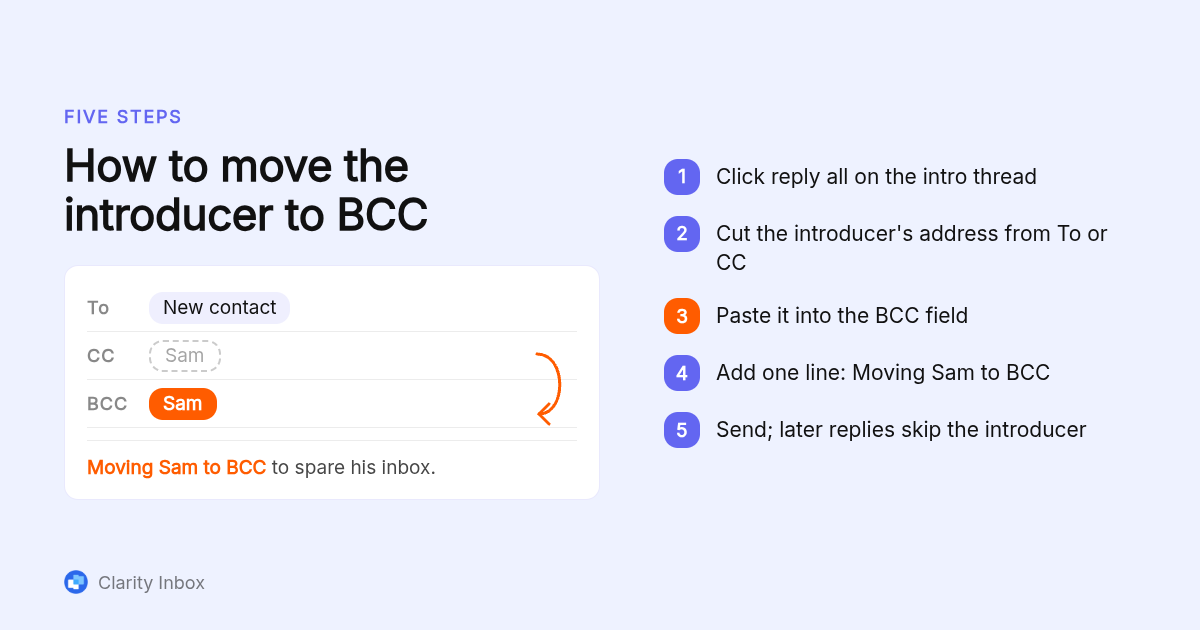
How do you move the introducer to BCC, and what do you write?
Click reply all, cut the introducer's address out of the To or CC field, paste it into the BCC field, and add one line near the top: "Moving Sam to BCC to spare his inbox." The introducer receives that one message as confirmation, and every reply after it goes only to you and the new contact.
BCC stands for blind carbon copy. People in the BCC field receive the message, but other recipients cannot see them, and a later reply all does not include them. Purdue's email etiquette guide covers the field conventions if you want the full background.
In Gmail, the BCC link sits at the right edge of the To field when you compose. In Outlook, open the Options tab and click BCC to show the field.
Three phrasings that work: "Moving Sam to BCC with thanks," "Sam to BCC so I don't flood your inbox," or simply "(Sam to BCC.)" Keep it to one line.
What should the first sentence say, and how do you reintroduce yourself?
Open by thanking the introducer by name, then turn to the new contact: "Thanks, Priya, for the introduction. Moving you to BCC. Dan, great to meet you." Then give one or two sentences on who you are and why this intro is relevant to them. Do not repeat the introducer's whole paragraph; they already read it.
A professional introduction email response has a word budget. One sentence of thanks, one BCC note, two sentences of reintroduction, one sentence stating the purpose, one proposing a next step. That is roughly 100 to 120 words.
The reintroduction should add something the intro did not: a specific relevance. "I run the order desk for a wholesale importer, and I understand you source from the same region" beats "I'm a business owner."
Resist selling in the first message. State what you are asking for or offering in plain words, and leave pricing and pitch for the call. If you want context before you write, Clarity's web search integration looks up who the new contact is and what their company does before you reply.
When should you propose a next step, and how specific should it be?
Propose the next step in the first reply, not the third. Offer two or three concrete windows, such as "Tuesday 10am or Thursday 2pm ET," or one scheduling link, and name the format and length: a 20-minute call. Vague offers like "let me know what works" push the scheduling work onto the other person and stall threads.
Always include a time zone. Introductions often cross regions, and a missed time zone is the most common reason a first call gets rebooked.
Give one fallback: "If neither works, here is my calendar link." That removes the second round of scheduling messages.
Email already eats a large share of the week. McKinsey's social economy research found knowledge workers spend about 28 percent of their workweek reading and answering email, so every reply that avoids a scheduling loop is time back. Clarity's Google Calendar integration reads your availability and works real open slots into draft replies automatically.
How fast should you respond to an introduction email?
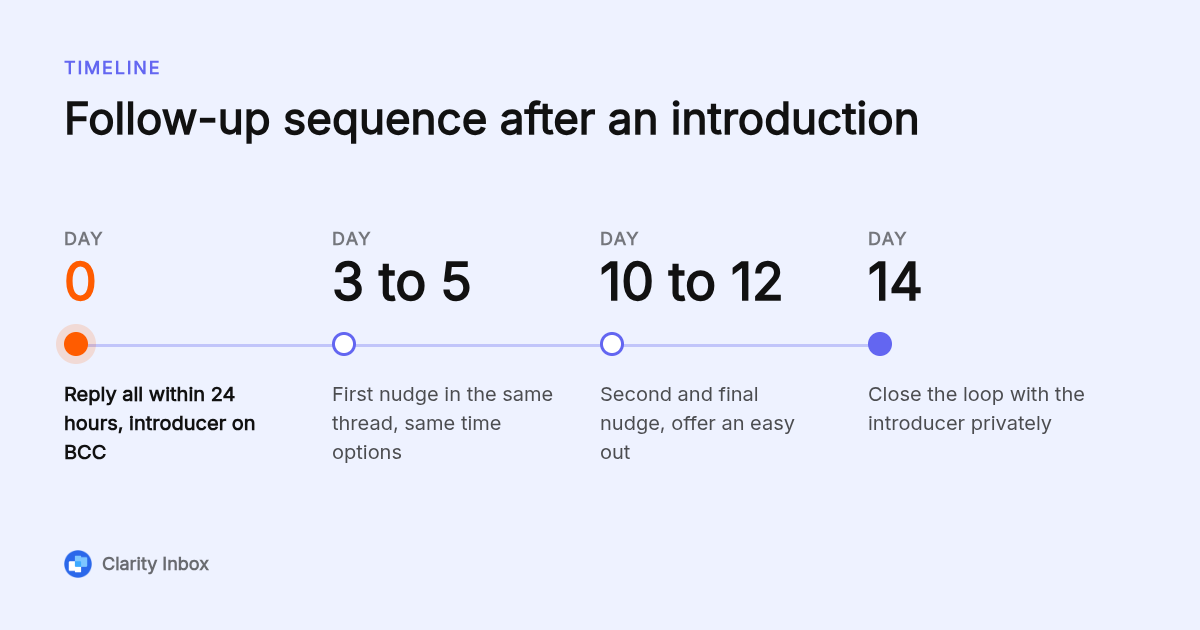
Reply within 24 hours, and the same business day if the intro is a sales lead. Keep the original subject line and stay in the same thread so the introducer and the new contact can find it later. If you cannot give a full answer that fast, send a two-line acknowledgement and promise a date.
Who replies first? The person who benefits most from the connection. If you asked for the intro, or you are the one selling, you go first. If it is genuinely mutual, whoever reads it first replies, and nobody loses points for it.
Do not change the subject line. "Re: Intro: Dan and Maria" is how both people will search for the thread in three months.
If replies slip past a day, the fix is usually tracking rather than willpower. Clarity's follow-up reminders for Gmail watch sent and received threads and flag the ones still waiting on you.
What are good introduction email response examples by scenario?
Every introduction email response example below follows one shape: thank the introducer, BCC them, reintroduce in two sentences, state the ask or offer, propose times. Use the short version when the intro was warm and the long version when the new contact knows nothing about you. Swap names and details, then send.
How do you respond to a sales introduction?
Short version:
Thanks, Priya. Moving you to BCC. Dan, great to meet you. We handle inbox and invoice follow-up for importers, and Priya mentioned your team is chasing POs by hand. Would a 20-minute call Tuesday at 10am or Thursday at 2pm ET work? Here is my calendar if neither does.
Long version:
Thanks for the introduction, Priya. Moving you to BCC to spare your inbox.
Dan, good to meet you. I'm Maria, and I run operations at a firm that works with trading companies managing orders over email. Priya mentioned your team is tracking deposits and factory updates in a spreadsheet.
I'd like to hear how that runs today before suggesting anything. Would Tuesday at 10am or Thursday at 2pm ET suit you for 20 minutes? If not, my calendar link is below.
How do you reply to a networking or job introduction?
Thanks so much, Priya. Moving you to BCC.
Dan, great to meet you. I'm a project manager with eight years in commercial electrical work, and Priya suggested you might have perspective on moving into estimating. I'd value 20 minutes of your time whenever suits. I'm free Wednesday morning or Friday after 1pm, and happy to work around you.
How do you reply to a mentor introduction?
Priya, thank you for connecting us. Moving you to BCC.
Dan, I appreciate you making time. I run a two-person plumbing company and I'm deciding whether to hire my first office admin. Priya said you made that call a few years ago. Could I buy you a coffee or a 20-minute call next week? Tuesday or Thursday both work on my end.
How do you reply to an academic introduction?
Thank you, Dr. Rao, for the introduction. Moving you to BCC.
Professor Lee, it's a pleasure to meet you. I'm a second-year master's student working on supply chain visibility in small importers, and Dr. Rao mentioned your lab's work on order tracking. I would be grateful for 20 minutes to ask about your methods. I'm available Monday or Wednesday afternoons, or whenever suits your schedule.
Is it okay to decline an introduction without burning the introducer?
Yes, as long as you still reply within the same 24 hours and thank both people. Say plainly that the timing or fit is not right, offer one alternative such as a resource, another contact, or a check-in date, and close warmly. Silence is what damages the relationship, not a polite no.
Decline template:
Thanks for thinking of me, Priya. Dan, good to meet you. We're fully booked through the quarter, so I can't take this on right now. Two shops I'd trust are below. If the timing shifts, I'd welcome a note in the spring.
If you were introduced without anyone asking you first, reply to the introducer privately before touching the thread. Thank them, and ask that future intros be double opt-in, meaning they check with you before connecting. Then reply on the thread with a short, polite decline or acceptance.
What do you do if the other person never replies?
Wait three to five business days, then send one short follow-up in the same thread with a fresh first line and the same time options. If a second nudge after another week gets nothing, close the loop with the introducer privately: thank them again and let them know it did not land, with no blame.
Follow-up template:
Dan, bumping this in case it slipped. The offer of a 20-minute call stands, and Tuesday or Thursday next week both work. If now isn't the time, no problem at all; just let me know and I'll stop nudging.
Two follow-ups is the limit. A third reads as pressure, and the introducer's reputation is attached to the thread.
Closing the loop matters. One line to the introducer, "No reply from Dan after two tries, but thank you again for the intro," keeps them willing to connect you next time. If you want subject line ideas for the nudge, our follow-up email subject lines page has 50 you can score before sending.
Why do service businesses hand introduction replies to Clarity?
Because the reply itself is easy and the volume is not. Clarity connects the Gmail or Outlook inbox you already use, learns your voice from sent mail, drafts the introduction email response, and flags the thread if the new contact goes quiet. Email management starts at $149/mo, with a $500 setup waived on a 12-month term.
To date Clarity has written 58,076 replies and sent 20,932 of them for 100+ service businesses. Every intro, deal, and project lands on a page we call a workstream, so you can see what was said, when, and who owes the next step.
The honest limit: Clarity does not send replies on its own. Drafts wait for your review, as shown on our auto-draft email replies for Gmail page, and chasing money never sends without you. If you want a tool that fires off replies unattended, this is not it.
Importers and trading companies running on purchase orders use the order desk instead, from $750/mo, and collections and reconciliation can be added to either quote.
How did we put this guide together?
We compared the reply structure recommended in published email etiquette guidance, the questions people ask in the forum threads that currently rank for this topic, and the scenarios where the Clarity team drafts introduction replies for clients. Timing, BCC mechanics, and the follow-up sequence came from that overlap. Client numbers come only from Clarity's own published figures.
How do you get started with Clarityinbox?
Connect the inbox you already use, and Clarity will draft your next introduction email response in your voice, file the thread on the right workstream, and flag it if the new contact goes quiet. See how Clarity turns inbox work into revenue and book your setup.
What do people also ask?
How do you begin an email reply to an introduction?
Start by thanking the introducer by name, note that you are moving them to BCC, then greet the new contact directly. Example: "Thanks, Priya, for the introduction. Moving you to BCC. Dan, great to meet you." That is three short sentences before you say anything about yourself.
How do I reply to an intro email?
Reply all within 24 hours, move the introducer to BCC, reintroduce yourself in two sentences, state what you are asking for or offering, and propose two or three specific times or a scheduling link. Keep the whole reply under 120 words and leave the original subject line unchanged.
How do you reintroduce yourself in an email?
Use one or two sentences that add relevance the introducer did not cover: your role, your company, and why this connection matters to the other person. Do not repeat the introducer's paragraph. "I run a two-person plumbing company and I'm deciding whether to hire my first admin" is enough.
How do I write an email introduction for two people?
Get both people's permission first, then send one email with both in the To field, a subject like "Intro: Dan and Maria," one sentence on who each person is, and one sentence on why they should talk. Ask them to take it from there and expect to be moved to BCC.
Should I send a separate thank-you to the person who made the introduction?
Yes, but briefly and after the thread has played out. Thanking them in the reply-all covers the moment. A separate one-line note a week or two later, saying whether the connection led anywhere, is what keeps them willing to introduce you again.