

Order Delayed From China What to Do: 6 Practical Steps
If you are searching for order delayed from China what to do, the answer is a timeline: wait out the normal transit window, message the seller with a deadline, open a not received dispute before the platform window closes, then fall back to PayPal or your card issuer if the seller stalls. If you run a business on purchase orders with Chinese factories, we recommend Clarity's Order desk, from $750/mo, which files every PO and email on the right order and flags silent factories before a late shipment turns into a lost season. Clarity is not a freight forwarder, a customs broker or a consumer dispute service; for a personal AliExpress or Temu parcel, the six steps below are the remedy.

Key takeaways
- Normal transit: China Post and ePacket parcels commonly take 2 to 6 weeks to reach the US, UK or Australia, so a parcel at day 20 with no local scan is not late yet.
- Dark period: tracking on China-origin parcels routinely shows no scans for 1 to 3 weeks between the departed country of origin status and the first destination scan.
- Deadlines: as of November 2026, eBay Money Back Guarantee claims close 30 days after the latest estimated delivery date and PayPal Purchase Protection closes 180 days after payment.
- Card fallback: the US Fair Credit Billing Act gives cardholders 60 days from the statement date to dispute a charge for goods not received.
- Business orders: Clarity's Order desk, from $750/mo, flags missed deposits, silent factories and unpaid invoices on every open purchase order; Mainbridge Import runs 261 live orders on it.
What counts as an order delayed from China?
An order delayed from China is a shipment that has passed the carrier's quoted transit window without a delivery scan, not merely a parcel with stale tracking. Economy post needs 2 to 6 weeks, express couriers 3 to 7 business days, and sea freight 30 to 50 days door to door, so judge lateness against the method you paid for.
| Shipping method | Typical door-to-door time | Where tracking usually goes quiet |
|---|---|---|
| China Post, ePacket, Yanwen economy | 2 to 6 weeks | After departed country of origin, until the first local scan |
| Cainiao consolidated (AliExpress Standard) | 2 to 5 weeks | During line-haul and import clearance |
| DHL, FedEx, UPS express | 3 to 7 business days | Rarely; a clearance hold shows within a day |
| Air freight (B2B) | 7 to 14 days | At the forwarder's warehouse before the flight |
| Sea freight, LCL or FCL (B2B) | 30 to 50 days | For the entire ocean leg |
These are typical ranges, not carrier guarantees. The carrier's own quote and the delivery estimate printed on your order page take priority, because platforms use that estimate to decide when a dispute can open.
Decision rule: a parcel is late when it has passed the top of its range or the order page estimate, whichever is later, with no delivery scan. Before that date, waiting is the correct action.
Why does tracking from China stop updating for weeks?
Tracking from China goes dark because the parcel sits in consolidation, waits for airline capacity, then clears export and import customs, none of which generate scans. A status like departed country of origin, handed to airline or arrived at destination is normal, and a gap of 1 to 3 weeks before the first local scan is routine, not a loss.
Here is how to read the statuses you will see on a China-side tracker:
- Label created or shipped: the seller printed a label. Nothing has moved, and some sellers sit here for days.
- Accepted by carrier or received by China Post: the first physical scan. Count transit days from here.
- Departed country of origin, handed to airline or export clearance complete: the parcel has left China. The dark period starts now.
- Arrived at destination country: import customs has it. Paste the number into your national carrier's tracker from this point on.
- Handed to local carrier or out for delivery: domestic tracking takes over and usually updates daily.
Economy mail travels in sealed consolidated bags. Nobody scans an individual parcel until the receiving post opens the bag, which is why a two-week silence tells you nothing either way.
Once a parcel shows arrived at destination, the destination carrier's own site is the authority. Aggregator trackers lag it by a day or more.
What are the 6 practical steps when an order from China is delayed?
The six steps are a timeline, not a menu: wait out the quoted window, message the seller with a documented deadline, check your national carrier and customs, open a platform not received dispute before the window closes, escalate to PayPal or your card issuer, and record the outcome so repeat sellers get judged on it. Day counts are below.
- Step 1, day 0 to the end of the quoted window: save screenshots of the order page, the delivery estimate and the tracking history. Do not message yet; sellers answer early questions with the same tracking link you already have.
- Step 2, quoted window plus 5 days: message the seller inside the platform, quote the order number and last scan, and ask for a new tracking number or a refund within 3 business days. A clear subject line helps; we keep a list of follow-up email subject lines for when nobody replied. Platform messages are evidence; WhatsApp chats usually are not.
- Step 3, the same week: check the destination carrier yourself. If the parcel shows arrived at destination, track it on USPS, Royal Mail or Australia Post, and if it has not moved for 7 days file a USPS Missing Mail search or your national equivalent.
- Step 4, no later than 7 days before the dispute window closes: open a not received dispute even if the seller has promised a reshipment. A dispute can be withdrawn later; an expired window cannot be reopened.
- Step 5, if the platform closes without a refund: escalate to PayPal within 180 days of payment, or to your card issuer within 60 days of the statement, attaching the dispute outcome.
- Step 6, within a day of the outcome: record the seller, the promised and actual lead time, and the result. One note takes a minute and stops you reordering from a seller who stalls.
Fast fail rule: if Step 2 gets no reply within 3 business days, skip straight to Step 4. Silence after a documented deadline is itself evidence.
How do you open a not received dispute on AliExpress, Temu or eBay?
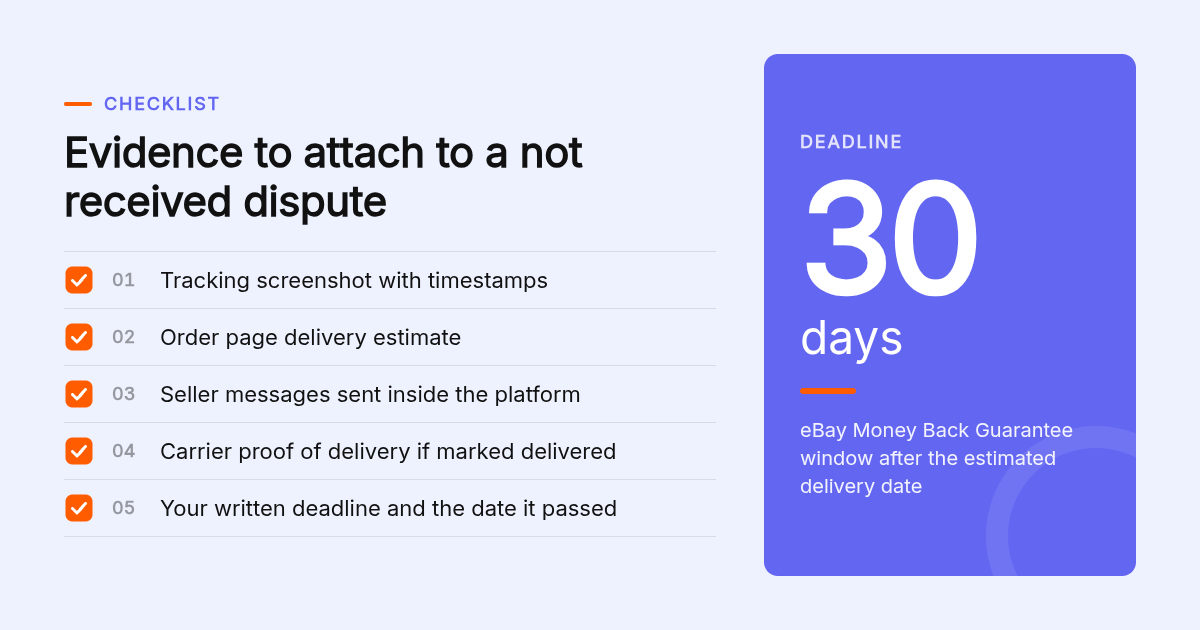
On AliExpress, Temu and eBay a not received dispute is opened from the order page, not by email, and the platform refunds from the seller's held funds if tracking shows no delivery. As of November 2026, eBay Money Back Guarantee allows 30 days after the estimated delivery date, while AliExpress and Temu tie the window to the order's delivery estimate.
On AliExpress, the Buyer Protection timer sits on the order page. The dispute option appears once the order has been in transit for a set number of days and stays open until 15 days after the order is marked complete; confirm the exact dates on your own order, as of November 2026.
On Temu, open Return or Refund from the order and choose the item not received reason. Temu's published policy covers most items for 90 days from purchase, as of November 2026, and parcels with no delivery scan are normally refunded without a return.
On eBay, choose I didn't receive it from the order. The eBay Money Back Guarantee policy gives 30 days after the latest estimated delivery date, as of November 2026. Shein and Wish use the same order-page route; Amazon marketplace orders go through the A-to-z Guarantee.
Attach four things to every dispute: the tracking screenshot with timestamps, the order page estimate, the seller messages, and, for delivered-not-received cases, the carrier's proof of delivery.
When should you escalate to PayPal or a credit card chargeback?
Escalate to PayPal or your card issuer after the platform dispute has closed without a refund, or when the seller sold outside a marketplace. PayPal Purchase Protection runs 180 days from payment, and US cardholders have 60 days from the statement date under the Fair Credit Billing Act, so file the platform dispute first and keep the card deadline visible.
PayPal's user agreement sets Purchase Protection for items not received at 180 days from the payment date, as of November 2026, and PayPal will ask whether you already disputed through the marketplace. The FTC explains that under the Fair Credit Billing Act you have 60 days from when the statement was sent to dispute a charge in writing.
A worked example makes the deadlines real. You pay $84 on 3 March, the statement carrying the charge goes out on 25 March, and the carrier estimate ends on 20 April.
The platform window closes around 5 May. The card dispute deadline is 24 May. PayPal stays open until 30 August. The card deadline is the tightest, which is why Step 4 says 7 days early.
Many issuers accept non-receipt disputes later under card network rules, but 60 days is the statutory right. A bank wire, the usual B2B payment method, has no chargeback at all.
Is your parcel stuck in customs, and how do you check?
A parcel from China can sit in customs for days to weeks, but a hold is only knowable once the destination carrier shows a customs status; China-side tracking will not say. Check with US Customs and Border Protection or your national postal service, confirm any duty owed, and respond to any letter within the stated deadline or the parcel returns.
CBP's guidance on internet purchases states that the buyer is the importer of record and owes any duty. Since May 2025, parcels from China and Hong Kong no longer qualify for duty-free de minimis entry into the US, so an unpaid duty request from the carrier is now a common reason a parcel sits, as of November 2026; confirm current rules on CBP's site.
In the UK, Royal Mail issues a fee to pay notice and holds the item for a limited period before returning it. Australia Post follows the same pattern, so check your mailbox and spam folder as well as the tracker.
Decision rule: if destination tracking shows a customs status for more than 10 business days with no request for payment or documents, contact the carrier, not the seller. The seller cannot see or act on destination customs.
How do you spot a shipping scam from a China seller?
The four common shipping scams are a tracking number that never shows an acceptance scan, a delivered status at a different address or weight, brushing parcels you never ordered, and a seller who promises reshipments until the dispute window expires. Treat a delivered scan with no parcel as a dispute trigger, not a reason to wait.
Fake tracking shows label created for 10 or more days, or tracks to a delivery in your city dated before you placed the order. Both are grounds to open the dispute immediately.
For delivered but not received, request proof of delivery from the carrier. USPS can show the delivery scan details and parcel weight; a 0.2 kg scan against a 2 kg order means a reused number, and that mismatch belongs in your dispute.
The US Postal Inspection Service describes brushing as unordered parcels sent so a seller can post verified reviews in your name. You may keep the item, but change passwords on any account that shows your address.
Stalling is the quietest scam. A seller who asks you to close the dispute before a reshipment arrives is timing the window; refuse, and let Step 4 run.
What should a business do when a Chinese supplier misses a delivery date?
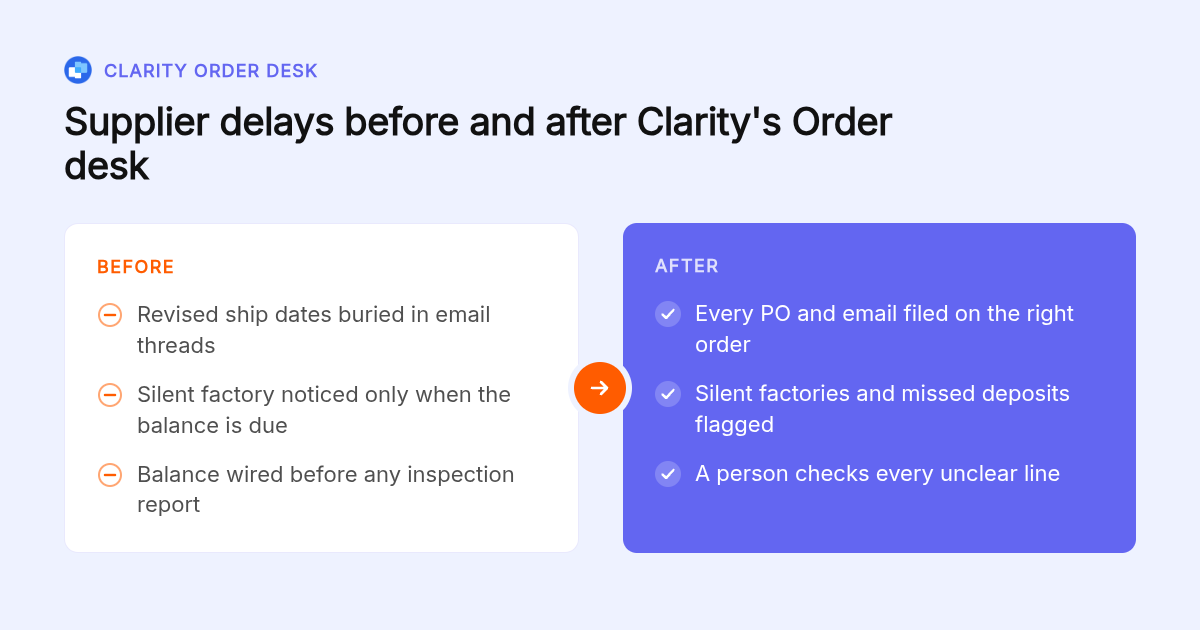
A business facing a late Chinese supplier should go back to the purchase order terms first: the agreed ship date, Incoterms, deposit schedule and any late delivery clause. Then get a written revised date, request production photos or a third party inspection, hold the balance payment until goods pass, and start qualifying a second supplier for the next PO.
The ICC Incoterms rules define where risk and cost transfer, so a missed FOB date is the factory's failure while a DAP delay may sit with the forwarder. If your PO has no late delivery clause, propose one on the next order: a credit per week late, capped, with a right to cancel after a fixed period.
A 30% wire deposit cannot be charged back, so the unpaid balance is your only lever. Never wire the balance before a pre-shipment inspection report, whatever the factory promises about the vessel cut-off.
Factory silence is the earliest signal of a slip, usually weeks before the missed date. Gmail users can set follow-up reminders that flag suppliers who have gone quiet so a silent thread surfaces on its own.
How does Clarity keep delayed supplier orders from going unnoticed?
Clarity's Order desk keeps delayed supplier orders visible by filing every purchase order and email on the right order, then flagging stalled orders: missed deposits, silent factories and unpaid invoices. A person on our team checks every unclear line, and each product and client carries quality memory, so a factory that slipped last season is flagged before the next PO.
This is what we have actually run, not a feature list. Mainbridge Import runs 261 live orders on Clarity, and across our clients we have logged 154,636 job updates and written 58,076 replies, the daily volume of revised ship dates, deposit confirmations and factory replies that otherwise sit unread.
The Order desk works with or without an ERP. Supplier mail is labelled automatically without rules to maintain, and Outlook users get a morning brief of which orders need attention before the factory's day ends.
Pricing is from $750/mo. As of November 2026, 10 seats remain at a $0 setup fee; after that setup is $500 and rises $250 every 10 seats, while the $750/mo never changes.
When a delay ends in a refund or credit note, our collections and reconciliation add-on reads the remittance as it lands and matches the payment to the invoice it settles.
How did we compare the refund routes in this guide?
We compared the published policy pages for eBay Money Back Guarantee, PayPal Purchase Protection and the FTC's guidance on the Fair Credit Billing Act, plus the order page dispute flows on AliExpress and Temu, as of November 2026. Carrier timelines come from carrier service estimates and the ranges printed on order pages.
How do you get started with Clarityinbox?
Getting started with Clarityinbox means connecting the inbox you already use, Gmail or Outlook, and letting us map how your orders run. For importers, the Order desk starts at $750/mo, works with or without an ERP, and as of November 2026 the 10 remaining seats carry a $0 setup fee. You keep your email; we keep every order current.
See how Clarity runs your orders from the inbox you already use
What do people also ask?
Why does delivery from China take so long?
Economy parcels from China move in consolidated mail bags that wait for airline space, then pass export customs in China and import customs at the destination before a local carrier takes over. Each handoff adds days and generates no scan, which is why China Post and ePacket typically take 2 to 6 weeks while DHL or FedEx express takes 3 to 7 business days.
Can I find out who sent me a package?
Check the shipping label for a sender name, return address and tracking number, then look the number up on the carrier's site for the origin. Carriers will not name the shipper beyond the label. If the parcel came from China and you ordered nothing, it is most likely a brushing parcel; the US Postal Inspection Service advises you may keep it and should check your online accounts.
My USPS package is 5 days late. What should I do?
First confirm the parcel has an arrived at destination scan, because 5 days past the estimate is common for China-origin mail during customs handoff. If USPS tracking shows no movement for 7 days, file a USPS Missing Mail search. If the platform dispute window is within 7 days of closing, open a not received dispute now rather than waiting on the search.
How reliable is China Post?
China Post delivers the large majority of parcels, but slowly and with sparse tracking. Registered mail gets a delivery scan at the destination; untracked economy mail shows nothing after leaving China. For anything time-sensitive or worth more than you are willing to wait 6 weeks for, pay for Cainiao with full tracking or an express courier.
How long should I wait before considering a package from China lost?
Wait until the top of the quoted range for the shipping method, plus 7 days with no new scan. For economy mail that is about 6 to 7 weeks from the acceptance scan; for express, 10 business days. Never let that waiting period run past your platform dispute window; open the dispute 7 days before it closes even if you are still hopeful.