

Supplier Hasn't Replied in a Week What to Do: 5 Next Steps
A silent supplier is a vendor whose confirmed order, quote or deposit has gone unacknowledged well past their normal reply time, and the answer to supplier hasn't replied in a week what to do is to follow up on a second channel today, send a dated written notice with a 48-hour deadline, then open a platform dispute or chargeback before the window closes. For importers who want that silence flagged on day 2 rather than day 7, we recommend Clarityinbox Order desk, from $750/mo, which files every purchase order and email on the right order and flags silent factories, missed deposits and unpaid invoices. Clarityinbox is not a payment platform, escrow service or dispute agent: it does not hold your money or file chargebacks for you. What it does is keep the record and the follow-ups current so you escalate on time with the evidence in hand.
Key takeaways
- Reply time: a reasonable reply time for a supplier is 1 to 2 business days; a full week of silence after a confirmed order or paid deposit is a red flag that needs escalation, not another polite nudge.
- Deadlines: PayPal gives buyers 180 days from the payment date to open a dispute, and the Fair Credit Billing Act gives credit card holders 60 days from the statement date, as of November 2026.
- Wire transfers: a wire or bank transfer carries no platform protection, so the remaining tools are a bank recall request, a formal written notice and small claims or legal action.
- Clarityinbox: Clarityinbox Order desk, from $750/mo, flags silent factories and missed deposits on the order they belong to, and Mainbridge Import runs 261 live orders on it.

At what day does supplier silence stop being normal and start needing action?
Wait one to two business days for a routine reply, then send a follow-up. After three business days with no acknowledgement, switch channels. A full week of silence on a confirmed order, open quote or paid deposit is a red flag: start the formal escalation sequence that day rather than waiting for a second week.
None of the forum threads ranking for this question give a day-by-day plan, so here is the one we use. Day 1: a short follow-up on the original thread. Day 3: the same question on a second channel, usually phone, WhatsApp or WeChat.
Day 7: a formal written notice with a 48-hour deadline, copied to a second person at the supplier. Day 9 or 10: open the platform dispute or notify your card issuer. Day 14: cancel, place a backup order and start any bank recall.
Adjust for time zones before you panic. A message sent Friday evening in Toronto lands Saturday morning in Shenzhen, so two silent days can be one working day. Automated email follow-up reminders that track who has not replied make the day-3 trigger hard to miss.
Which details turn a week-late chaser into something a supplier actually answers?
A follow-up after a week of silence should be short, dated and specific. State the order or PO number, the amount paid, the last promised date, and one clear question with a reply deadline. Send it on the original thread and again on a second channel so a missed email is no longer a possible excuse.
Here is a template you can paste and edit:
Subject: PO 2291: production status needed by Thursday
Hi Mei, following up on PO 2291 (deposit of $3,600 paid 14 October). The confirmed ship date was 4 November and we have had no update since 28 October. Please confirm current production status and the new ship date by Thursday 12 November. If we do not hear back, we will need to escalate through Trade Assurance.
The deadline turns a vague nudge into a decision point. The named consequence tells the supplier you know the process. If your first subject line was buried, these follow-up email subject lines for when nobody replied are written for exactly this situation.
Many factories answer WeChat or WhatsApp within hours while email sits for days. Use the platform messenger too, because disputes on Alibaba and eBay look at the conversation held inside the platform.
Why do suppliers go quiet, and how do you tell a delay from a scam?
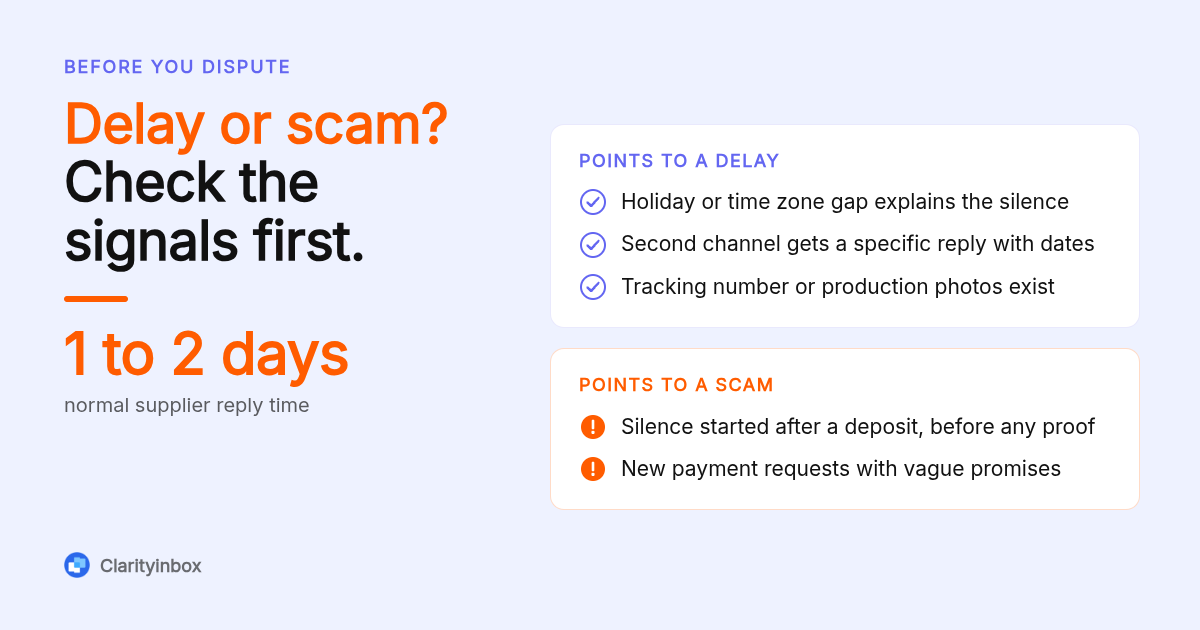
Suppliers go quiet for five reasons: public holidays, time zone gaps, a missed or filtered email, a stock or production problem they do not want to admit, or a scam. The test is the pattern. A delayed supplier eventually answers a second channel with specifics; a scam stays silent everywhere or answers with vague promises and new payment requests.
Check the calendar first. Chinese New Year and the early October Golden Week close many factories for weeks, and the backlog on reopening can add another week of slow replies. A supplier who warned you about the holiday is not a problem; one who vanished without warning is.
Then check the order record before opening anything. Pull the proforma invoice lead time, the deposit receipt date, any tracking number and the platform order page. If a tracking number exists, the carrier may hold the answer, not the supplier.
Our decision rule: silence that begins right after a deposit and before any production photo is high risk, so move to a formal notice immediately. Silence that begins after a shipment confirmation is usually logistics, so give the carrier two days first.
When should you send a formal written notice, and what should it contain?
Send a formal written notice on day seven of silence. The notice names the order number, amount paid, the promised delivery or lead-time date, the date of each unanswered message, and a 48-hour deadline to respond. The notice states what happens next: dispute, chargeback or cancellation. Keep a dated copy because platforms and courts both ask for it.
Documentation is the step the forum threads skip, and it decides most disputes. Keep the contract or proforma invoice, every payment receipt with its date, every message with a timestamp, screenshots of platform chat, and any product photos or inspection reports.
Copy a second address at the supplier: the sales manager, the general company email, or the sourcing agent who introduced you. One silent salesperson is a common cause of a week with no reply, and a copied manager often answers within a day.
A final notice can be three lines: the facts, the deadline, the consequence. Avoid threats you will not carry out. Platforms read the tone, and a calm written record is stronger evidence than an angry one.
Which platform case or card protection applies once the supplier has gone fully silent?
Open the dispute on the platform that holds the money, then fall back to the payment method. Alibaba Trade Assurance, eBay and Amazon each run a case where the seller gets a short response window before the platform steps in. If no platform applies, PayPal and credit card chargebacks have filing deadlines measured from the payment date.
The deadlines matter more than the wording. Under the eBay Money Back Guarantee, as of November 2026, a buyer reports an item not received within 30 days of the latest estimated delivery date, the seller gets 3 business days to respond, and the buyer can then ask eBay to step in.
PayPal Purchase Protection allows 180 days from the payment date to open a dispute, as of November 2026, and an unescalated dispute closes after 20 days, so escalate it to a claim rather than letting it auto-close. For credit cards, the FTC explains that the Fair Credit Billing Act gives you 60 days from the date the statement with the charge was sent.
For wholesale orders, Alibaba Trade Assurance lets you file a dispute on the order itself after the agreed ship date passes; confirm the current filing window in your order terms because it varies by order. If the supplier replies inside the case but still does not ship or refund, ask the platform to decide instead of accepting a new promise.
What can you do if you paid by wire transfer with no platform protection?
A wire transfer or bank transfer has no buyer protection, so a silent supplier leaves you with four options: ask your bank for a recall request immediately, send a formal demand letter, file in small claims court where the contract allows, or negotiate a partial refund. Act fast because recalled wires rarely succeed once funds are withdrawn.
A recall only works while the funds sit in the receiving account, so call the bank the day you decide the silence is not a delay. Legal routes exist but are slow across borders. In England and Wales, for example, the government's court claim for money process handles claims up to £10,000 on the small claims track, as of November 2026, but enforcing a judgment against an overseas factory is a separate problem.
Prevention is cheaper. Here is the arithmetic on a $12,000 order: paying 30% deposit and 70% against a copy of the bill of lading puts $3,600 at risk during a silent week; paying in full up front puts the whole $12,000 at risk. For first orders, use Trade Assurance or a letter of credit rather than a bare wire.
Should you cancel the order and source elsewhere, or keep waiting?
Cancel and re-source when the supplier has missed the written notice deadline, the platform dispute window is about to close, or the delay now costs more than the deposit at risk. Keep waiting only if the supplier has replied on any channel with a specific new date and you have protection that outlasts that date.
Run the numbers rather than the feelings. If a $3,600 deposit is at risk but the customer order it feeds is worth $20,000 and due in three weeks, a backup order from a second vetted supplier today is cheaper than another silent week.
Whether to keep the supplier afterward depends on the explanation. One silent week with an honest reason and a fixed delivery is forgivable. Two is a pattern. Either way, write a communication clause into the next PO: reply within 2 business days, a weekly production update with photos, and a named backup contact.
Where does a quiet factory show up inside Clarityinbox Order desk?
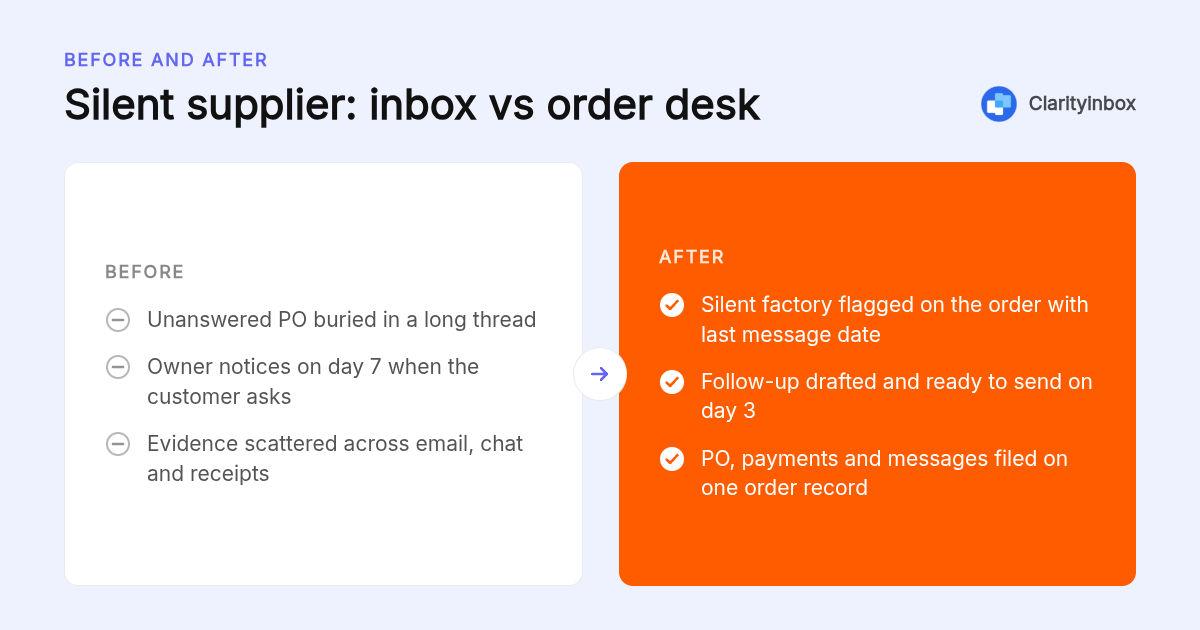
Clarityinbox Order desk files every purchase order and email on the right order, then flags stalled orders: missed deposits, silent factories and unpaid invoices. A person checks every unclear line, so a factory that has gone quiet shows up as a flagged order with the last message date, not as a thread buried in an inbox.
This is what we see inside importer inboxes every day. The stall almost never announces itself; it appears as an unanswered PO or a deposit nobody confirmed, and the owner notices on day 7 because that is when the customer asks. Across our clients we have logged 154,636 job updates and written 58,076 replies, as of November 2026, and the silent-factory flag is the one importers tell us they would not want to lose.
Mainbridge Import runs 261 live orders on Clarity. Order desk starts at $750/mo, works with or without an ERP, and currently has 10 seats left at a $0 setup fee, then $500, rising $250 every 10 seats; the $750/mo never changes.
For service businesses that are not importing, Email management from $149/mo watches the same thing on a smaller scale: people gone quiet, overdue follow-ups and deals with no next step, with a $500 setup fee waived on a 12-month term. When a follow-up is due, AI-drafted replies in your own voice are ready to review, and a chase for money never sends without you.
Which sources and deadlines sit behind this day-by-day plan?
We compared the published dispute policies of eBay, PayPal and Alibaba, the FTC's guidance on the Fair Credit Billing Act, and the UK government's small claims process, all checked in November 2026. We then matched those deadlines against where stalled orders actually surface in the importer inboxes Clarityinbox runs. The day-by-day timeline is our working method, not a survey.
How do you get started with Clarityinbox?
Getting started with Clarityinbox means connecting the inbox you use, then the Clarity team maps how your orders or deals run and begins filing emails, purchase orders and documents on the right workstream. Stalled orders are flagged on the order they belong to, and the Clarity team keeps it current and sends you a report every month.
If a supplier going quiet is costing you deposits or customers, see how Clarityinbox Order desk tracks every order from PO to payment.
What do people also ask?
What should I do if the seller has not responded to my offer?
An offer with no reply is not an order, so there is nothing to dispute yet. Follow up once after 2 business days with a clear expiry date on the offer, try a second channel on day 3, and after a week send the same request to one or two alternative suppliers. A supplier who cannot answer a quote in a week will not answer a production problem faster.
What can you do if a company won't refund your money?
Send a dated written demand with the order number, amount and a 48-hour deadline, then use the strongest protection you have: a platform case such as eBay or Alibaba Trade Assurance, a PayPal dispute within 180 days of payment, or a credit card chargeback within 60 days of the statement, as of November 2026. If you paid by wire, ask your bank for a recall immediately and consider small claims court.
What happens when the seller doesn't do the repairs?
Treat an agreed repair or rework the seller never does like a non-delivery. Put the agreed repair, the date promised and your evidence in a written notice with a deadline, then open a not-as-described or warranty case on the platform or with your card issuer. If the agreement is a private contract, the remedies are the ones written in it plus small claims court.
What if the seller does not respond to a refund request?
Give the seller 3 business days, then escalate inside the platform case rather than sending more messages. On eBay the seller has 3 business days to respond before you can ask eBay to step in; on PayPal escalate the dispute to a claim before it auto-closes after 20 days. Keep every message dated, because the platform decides on the record, not on the latest promise.
Is a week of silence normal for overseas suppliers, or is it a scam sign?
A week of silence is normal only around major holidays such as Chinese New Year or October's Golden Week, or when a message sits across a weekend and a time zone gap. Outside those windows it is a red flag. The quickest test is a second channel: a genuine supplier answers WeChat, WhatsApp or a phone call with specifics, while a scam stays silent everywhere or asks for more money.