

How to Follow Up on an Unpaid Invoice From a Customer Politely
The short version of how to follow up on an unpaid invoice from a customer is a fixed ladder: a courtesy note three days before the due date, a friendly reminder on day 1, firmer emails on day 7 and day 14, a phone call by day 21, and a final notice at day 30. For service businesses that would rather not run that ladder by hand, we recommend Clarityinbox, which drafts every chaser inside the inbox you already use and matches each payment to the invoice it settles, with email management from $149/mo and collections added to your quote as of November 2026. Clarityinbox is not a collections agency or a law firm, and it never sends a payment chaser without your approval.
An unpaid invoice follow-up is a scheduled series of reminders, each one firmer than the last, that asks a customer to settle a bill after its due date has passed. Done well, it collects the money and keeps the customer.
Key takeaways
- The ladder: a courtesy note on day -3, reminders on day 1, day 7 and day 14, a phone call by day 21, and a final notice with a seven-day deadline on day 30 recovers most invoices without a dispute.
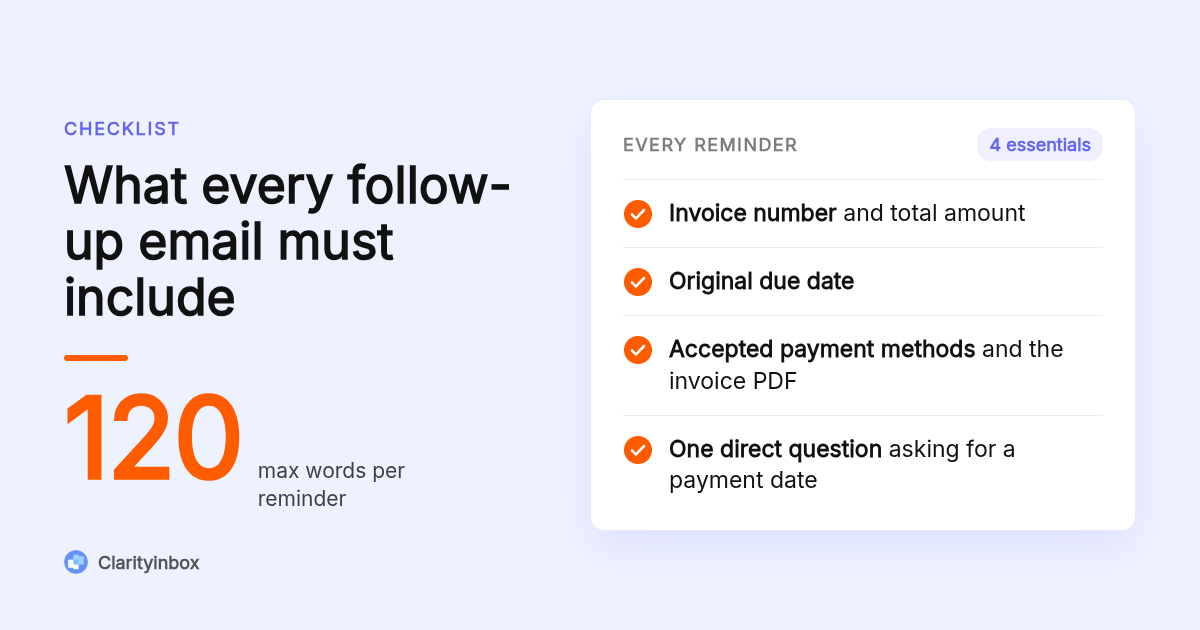
- Every reminder needs the invoice number, amount, original due date, accepted payment methods, and one direct question asking for a payment date.
- Clarityinbox has tracked 3,878 invoices and matched 1,230 payments for 100+ service businesses as of November 2026, and chasing money never sends without the owner's approval.
- UK businesses can charge statutory interest of 8% plus the Bank of England base rate on late commercial payments, according to GOV.UK.
- Decision rule: pause ongoing work at 14 days overdue, and stop chasing yourself at 60 days; after that it is a late fee, a payment plan, a collections agency, or small claims.

How soon after the due date should you send the first follow-up on an unpaid invoice?
Send the first follow-up on an unpaid invoice one business day after the due date, and send a courtesy note three days before it. A customer who meant to pay usually settles after the day 1 note. Waiting a week signals that your terms are flexible, and every later step in the ladder slips with it.
Here is the day-by-day timeline we use. Each step has one job, and each one is a little firmer than the last.
- Day -3: a courtesy note confirming the invoice arrived and the due date is coming up.
- Day 1: a friendly reminder with the invoice attached, assuming it was simply missed.
- Day 7: a second reminder that asks for a specific payment date.
- Day 14: a firmer email that mentions late fees if your terms include them, and pauses new work.
- Day 21: a phone call that ends with a committed date.
- Day 30: a final notice with a seven-day deadline and a clear statement of what happens next.
Adjust the gaps for your industry, but keep them fixed. A ladder that moves is not a ladder.
What should you check before chasing a customer for payment?
Before chasing, confirm the invoice went to the right person, the amount matches the quote, the due date is correct, and no dispute is open in the thread. A wrong contact or a missing PO number explains a large share of late payments, and chasing a customer for your own error damages the relationship.
Run this five-point check before you send anything. It takes two minutes and saves an awkward apology.
- Did the invoice reach the billing contact, not just the person who hired you?
- Does the amount match the signed quote or change order?
- Is the PO number, job address, or reference the customer asked for on the invoice?
- Are your bank details and payment link current?
- Has anyone in the thread raised a complaint about the work?
If point five is a yes, stop the ladder. Resolve the dispute first, then restart from day 1 with a corrected invoice.
What should an unpaid invoice follow-up email say and include?
An unpaid invoice follow-up email should include the invoice number, the amount due, the original due date, a link or attachment to the invoice, the accepted payment methods, and one direct question asking when payment will be sent. Keep the body under 120 words so the ask is visible without scrolling.
Below are four copy-and-paste templates, one for each stage. Swap the bracketed details and keep the rest. For subject lines that get opened, our list of invoice email subject lines for reminders and overdue notices covers every stage.
Day 1, friendly reminder:
Subject: Invoice [number] was due [date]
Hi [name], a quick note that invoice [number] for [amount] was due on [date]. I have attached it again in case it was missed. You can pay by [methods]. Could you let me know when it will be sent? Thanks, [your name]
Day 7, second reminder:
Subject: Second reminder: invoice [number], [amount]
Hi [name], invoice [number] for [amount] is now seven days past due. If there is a problem with the invoice, tell me and I will fix it today. Otherwise, could you confirm a payment date by [day]? Thanks, [your name]
Day 14, firmer reminder:
Subject: Invoice [number] is 14 days overdue
Hi [name], invoice [number] for [amount] is 14 days overdue and I have not heard back. Per our terms, a late fee of [fee] applies from [date]. I am pausing [next scheduled work] until it is settled. Please reply with a payment date. [your name]
Day 30, final notice:
Subject: Final notice: invoice [number]
Hi [name], this is the final notice for invoice [number], [amount], now 30 days overdue. If payment is not received by [date, seven days out], I will refer the account to [collections agency or small claims]. I would much rather settle this directly. Call me on [phone]. [your name]
How do you ask a customer to pay an overdue invoice without sounding rude?
Ask for payment without sounding rude by writing about the invoice, not the person: state the facts, name a date, and offer a way out such as a payment plan. Firmness comes from consistency, not from tone. Customers rarely resent a predictable reminder; they resent surprise, vagueness, and being copied to their boss without warning.
Three rules keep the tone professional. First, never apologise for asking; an apology invites the customer to treat the invoice as optional. Second, give one clear next step per email, never three. Third, keep every email short enough to read on a phone.
If writing chasers drains you, Clarityinbox can draft the reply in your own voice from your sent mail, so the tone stays yours while the facts stay accurate. Our follow-up email subject lines for when nobody replied help when the thread has gone quiet.
When should you pick up the phone instead of emailing about an invoice?
Pick up the phone once two emails have gone unanswered, usually around day 21, or sooner when the invoice is large relative to your month. A call takes three minutes and ends with a committed date, which an email thread rarely does. Follow every call with a short email recapping what was agreed.
A simple script: "Hi [name], it is [you] from [business]. I am calling about invoice [number] for [amount], due on [date]. I want to make sure nothing is wrong on our side. When can I expect payment?" Then stop talking and let them answer.
The three most common excuses, and how to handle each:
- "I never received it." Confirm the correct email address on the call, resend while still on the phone, and ask for a date before you hang up.
- "Cash flow is tight this month." Offer a plan: half now, half in 14 days, in writing the same day. A partial payment beats a silent debtor.
- "I am not happy with the work." Separate the dispute from the invoice. Agree what is disputed, invoice the undisputed part, and fix the rest.
What can you do if a customer refuses to pay or ignores every reminder?
When a customer ignores every reminder, you have five options in rising order of cost: add late fees, offer a payment plan, pause work, hand the invoice to a collections agency, or file in small claims court. Choose based on the amount owed, whether the customer is still reachable, and whether you want them back.
| Option | Use when | Cost to you | Limit to know |
|---|---|---|---|
| Late fee or interest | Terms already state it | None | Only enforceable if it was in the agreed terms |
| Payment plan | Customer is reachable and honest about cash flow | Delayed cash | Get it in writing with dates |
| Pause work | Ongoing project, 14+ days overdue | Lost momentum | Check your contract allows suspension |
| Collections agency | Customer unreachable, you do not need them back | Contingency fee, a share of what is recovered | Confirm the rate in writing first |
| Small claims court | Amount is under the local limit, you have documents | Filing fee plus your time | Winning does not guarantee collecting |
Late fees depend on your terms and your jurisdiction. In the UK, GOV.UK sets statutory interest on late commercial payments at 8% plus the Bank of England base rate, plus a fixed recovery sum of £40, £70 or £100 depending on the debt size, as of November 2026. In the US there is no federal rate, so put the fee in your contract.
Small claims limits vary by state. In California, the state courts' self-help site lists a limit of $12,500 for individuals and $6,250 for businesses as of November 2026. Check your own state's limit before filing.
Our decision rule: at 60 days overdue, stop chasing yourself. If the amount is under your small claims limit and the customer is reachable, file. If the customer has vanished, use an agency. If the amount exceeds the limit, talk to a lawyer.
How do you track and view unpaid invoices in QuickBooks or Xero?
In QuickBooks Online, open Sales, then Invoices, and filter by Overdue, or run the Accounts Receivable Aging Summary under Reports to see every open invoice grouped by days late. In Xero, open Business, then Invoices, and use the Overdue tab. Both tools can send automatic reminders on dates you choose.
QuickBooks also lets you turn on automatic reminders per customer, and Xero Central documents invoice reminders that fire before and after the due date, as of November 2026. Confirm the current menu paths in each vendor's help centre, since both products change their navigation.
The limit of both: an aging report shows what is late, not why. Automatic reminders go to the billing contact on file even when that person has left, and neither tool reads the reply that says "paid by e-transfer yesterday".
How does Clarityinbox follow up on unpaid invoices for you?
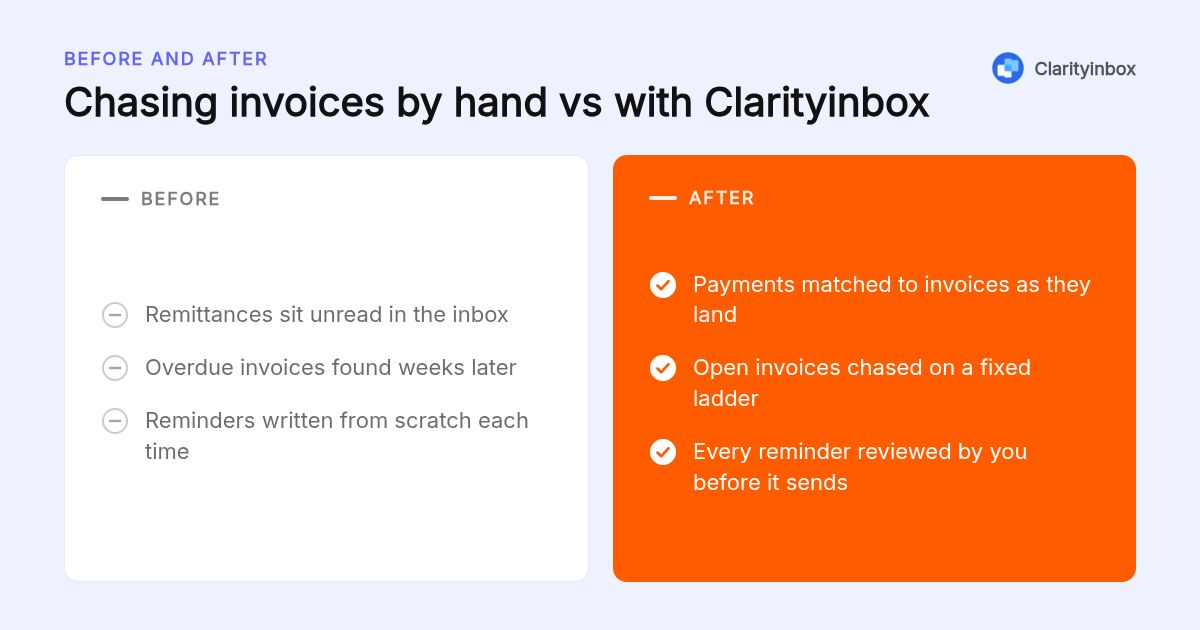
Clarityinbox connects to the Gmail or Outlook inbox a service business already uses, reads remittances, e-transfer notices and bank statements as they land, matches each payment to the invoice it settles, and drafts the next chaser for anything still open on the same follow-up ladder. Nothing goes out until the owner approves it.
As of November 2026, we have tracked 3,878 invoices and matched 1,230 payments for 100+ service businesses, alongside 58,076 replies written and 20,932 sent. The collections and reconciliation service is added to your quote and runs alongside email management, which starts at $149/mo with a $500 setup fee waived on a 12-month term.
The practical difference from an accounting reminder is context. Clarity tracks sent emails and flags who has not replied, so a customer who went quiet on day 7 shows up before day 14. Overdue invoices also appear in your morning brief of what needs attention, ranked by urgency. A person on our team checks every unclear payment line.
How did we compare these options?
We compared three ways of chasing an unpaid invoice: running the ladder by hand from a calendar, the built-in reminder and aging features documented in the QuickBooks and Xero help centres, and our own collections workflow, using each vendor's published help pages and our own pricing.
How do you get started with Clarityinbox?
Getting started with Clarityinbox means connecting the inbox you already use, letting us learn how your business runs, and approving the first chasers we draft. Email management starts at $149/mo as of November 2026, and collections and reconciliation are added to your quote. The $500 setup fee is waived on a 12-month term.
If you send invoices and then have to wonder about them, see how Clarityinbox turns leads into revenue and ask us to quote collections alongside it.
What do people also ask?
How do I view unpaid invoices in QuickBooks?
In QuickBooks Online, go to Sales, then Invoices, and filter the list by Overdue. For a view grouped by days late, open Reports and run the Accounts Receivable Aging Summary. Confirm the current menu path in the QuickBooks help centre, since navigation changes between versions.
How do I professionally ask someone to pay their invoice?
State the invoice number, amount and due date, attach the invoice, list the payment methods, and ask one direct question: when will payment be sent? Keep it under 120 words, do not apologise for asking, and send it on a fixed schedule so the request feels routine rather than personal.
What should I do if invoices are unpaid?
First verify the invoice went to the right contact with the right details. Then run a reminder ladder: day 1 friendly, day 7 ask for a date, day 14 firmer with any late fee and paused work, day 21 phone call, day 30 final notice with a seven-day deadline.
What can I do if a customer won't pay an invoice at all?
After the final notice, choose by amount and reachability: offer a written payment plan if the customer is honest about cash flow, hand the account to a collections agency if they have vanished, or file in small claims court if the amount is under your local limit and you have the documents.
How many reminders should I send before escalating an unpaid invoice?
Send three emails (day 1, day 7, day 14), then one phone call around day 21, then one final notice at day 30. If 60 days pass with no payment or agreed plan, stop chasing yourself and move to late fees, a collections agency, or small claims.