

Responding to an Introduction Email: A Step by Step Guide
Responding to an introduction email takes three moves: reply within 24 hours, thank the introducer and move them to BCC, then make one specific ask of the new contact. If introductions land between the client threads you are already juggling, Clarityinbox drafts those replies in your voice and flags who still owes the next step, with email management from $149/mo as of November 2026. Clarity is not an autoresponder: every draft waits for your review before it sends.

Key takeaways:
- A reply to an introduction email should go out within 24 hours and run under 150 words, because the new contact has never met you and will judge you on brevity.
- Moving the introducer to BCC on your first reply lets them see you followed through without receiving every later message in the thread.
- Keeping the original "Re:" subject line is the right default; change the subject only when the conversation becomes a concrete quote, project or order.
- One specific ask with two proposed time slots gets answered faster than an open "let me know when you are free".
- Clarityinbox has written 58,076 replies and sent 20,932 of them for more than 100 service businesses as of November 2026, with email management priced from $149/mo.
What does responding to an introduction email actually involve?
Responding to an introduction email is the reply you send after a mutual contact connects you with someone new in one thread. A complete response thanks the introducer, greets the new contact, states who you are in one line, makes a single small ask, and closes with a professional sign-off, all inside 24 hours.
The sequence matters because three people are reading. The introducer wants proof you followed through, the new contact wants to know why you are worth their time, and you want a next step on the calendar.
Brevity is not optional. A 2012 McKinsey Global Institute report estimated that knowledge workers spend 28 percent of the workweek reading and answering email, per McKinsey's social economy research, so every extra paragraph costs the reader real time.
If you want the tone side covered in more depth, our earlier guide to writing an introduction email response that gets a reply pairs well with the steps below.
How fast should you reply, and how long should the reply be?
Reply to an introduction email within 24 hours, and within the same business day when the introducer is a client or referral source. Keep the body under 150 words. A fast, short reply shows you respect the introducer's social capital; a slow one makes the introducer look bad for vouching for you.
Speed stands out more than people think. SuperOffice's customer service benchmark study found the average company took more than 12 hours to answer an email, so a reply inside a few hours already puts you ahead.
If you cannot give a full answer in 24 hours, send a two-line holding reply. "Thanks for the intro, Dana. Priya, great to meet you. I am travelling until Thursday and will send proper times then."
A simple decision rule: an intro that lands on Friday afternoon can wait until Monday morning. Anything past 48 business hours needs an apology line at the top.
Should you reply all or move the introducer to BCC?
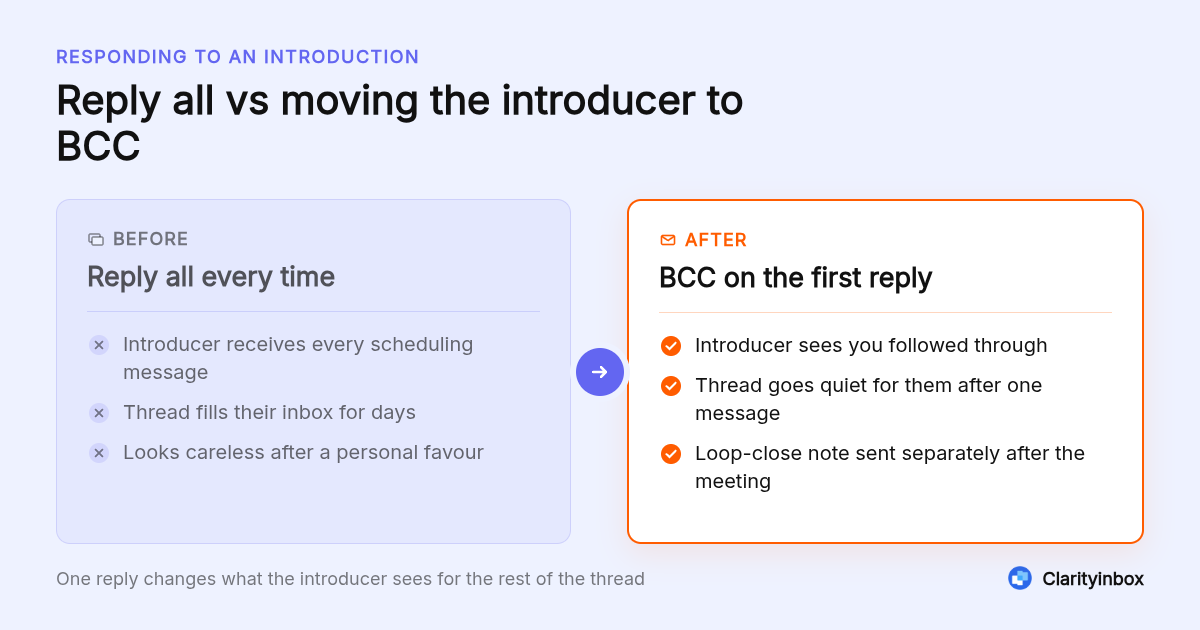
Reply all once to an introduction email, with the introducer moved from CC to BCC, and say so in your first line. The introducer gets proof you followed up without receiving every scheduling message that follows. Replying all for the whole thread clutters their inbox; dropping them silently looks like you ignored their effort.
The mechanics are the same in both major clients. Gmail's help centre documents that BCC recipients are hidden from everyone else on the message, and Microsoft Support covers how to show the BCC field in Outlook when it is collapsed by default.
The first line does the work. "Moving Dana to BCC to spare her inbox. Thank you, Dana, for making this happen." The introducer sees your reply, then the thread goes quiet for them.
One exception: keep the introducer in CC when they explicitly asked to stay involved, for example a client introducing you to their builder on a job they are paying for.
How do you thank the person who made the introduction?
Thank the introducer twice: once in the first line of your reply to the introduction thread, and once in a separate one-line note after you have met the new contact. The first thank-you is public and brief. The second closes the loop and tells the introducer whether their effort led anywhere, which is what earns the next introduction.
The loop-closing note is the step most advice skips. "Dana, quick note: Priya and I spoke Tuesday and she is sending a brief for the warehouse move. Thank you again." Three sentences, sent as a fresh email, not in the original thread.
Introducers stop introducing when they never hear what happened. A 20-second update after the meeting is the cheapest referral marketing a service business can do.
What should you write to the new contact, including the ask?
Your first message to a new contact after an introduction should greet them by name, explain who you are and why the introduction makes sense in two sentences, then make one small, specific ask with two proposed times. Keep the tone professional because you have never met. Leave attachments and pitch decks out of the first message.
The structure is greeting, one line of context that echoes the introducer's reason, one ask, two slots. "Priya, Dana mentioned you are moving your warehouse in January. We handle commercial fit-outs across the North Shore. Would a 15 minute call suit on Tuesday at 10am or Thursday at 2pm?"
Size the ask to the relationship. Ask for 15 minutes on a sales intro, coffee on a peer intro, and a single written question on a mentor intro.
Spend two minutes on research before you write. Clarity's web search integration researches a contact and their company before you reply, which is how you find the one detail that makes the context line land.
What subject line and sign-off should you use?
When responding to an introduction, keep the original subject line with "Re:" in front, for example "Re: Intro: Priya and Mark", so both people recognise the thread. End the reply with one closing line, a plain sign-off such as "Best regards", and a signature carrying your name, role, company and phone number.
Change the subject only when the thread becomes something else, such as a quote or an order. "Warehouse fit-out quote (was: Intro: Priya and Mark)" keeps the history searchable while signalling the shift.
Good closing lines are short and forward-looking: "Looking forward to speaking" or "Happy to work around your schedule." Then your sign-off, then a signature with a booking link if you have one.
Which reply templates fit each introduction scenario?
Five reply templates cover the common introduction scenarios: a job referral, a networking intro, a sales or partnership intro, a mentor intro, and an introduction you need to decline. All five share one skeleton: thank the introducer, move them to BCC, greet the contact, add one line of context, make one ask. Only the ask and tone change.
Job referral intro:
Thanks so much, Dana (moving you to BCC). Priya, great to meet you. Dana mentioned your team is hiring an operations coordinator. I have spent four years running dispatch for a 12-van plumbing firm. Could I send my CV and grab 15 minutes this week?
Networking intro:
Thank you, Dana (to BCC). Hi Priya, lovely to connect. We both run service businesses on the North Shore, and Dana thought we would have plenty to compare notes on. Would coffee on Tuesday or Thursday morning suit?
Sales or partnership intro:
Appreciate the intro, Dana (BCC). Priya, thanks for being open to a conversation. We handle commercial electrical fit-outs and Dana mentioned your January warehouse move. A 15 minute call on Wednesday at 10am or Friday at 2pm would let me understand your timeline.
Mentor intro:
Thank you, Dana (moving you to BCC). Priya, I really appreciate you making time. I am two years into running my own practice and have one specific question about pricing retainers. Could I send it by email, or take 20 minutes next week?
Declining an intro:
Dana, thank you for thinking of me. Priya, it is good to meet you. We are fully booked on fit-outs through March, so I cannot take this one on. Happy to point you to two firms I trust if that helps.
When declining, reply all without BCC. The introducer should see the polite close and the reason, so they can redirect Priya without guessing.
When should you follow up if nobody replies?
If the new contact has not replied to your introduction response after five business days, send one short follow-up in the same thread with the introducer still on BCC. If another week passes, send one final message that makes replying easy, then stop. Two follow-ups is the limit; a third makes the introducer regret connecting you.
Keep the follow-up to two sentences. "Priya, bumping this in case it slipped. Tuesday or Thursday still work on my end." Stay in the same thread rather than starting fresh, because the thread carries the introducer's endorsement.
Silence is usually overload, not rejection. University of California, Irvine research led by Gloria Mark found people take around 23 minutes to return to a task after an interruption, which is how a well-meant intro reply slides to page two.
The practical problem is remembering to follow up at all. Clarity's follow-up reminders for Gmail flag sent emails that never got a reply, so the five-day rule runs without a mental list.

How does Clarity handle introduction replies for service businesses?
Clarityinbox connects to the Gmail or Outlook inbox a service business already uses, reads each introduction thread, drafts a reply in the owner's voice, and files the thread on a workstream that shows who owes the next step. Drafts wait for review.
What we see inside those inboxes is that intros rarely fail on writing skill. They fail because the thread lands between an invoice query and a quote, and nobody opens it again until the introducer asks.
Clarity catches that. The workstream shows what was said, when, and who owes the next step, and it flags people gone quiet and overdue follow-ups. The Clarity team keeps it current and sends a report every month.
The reply itself comes from Clarity's auto-drafted replies in Gmail, written to sound like you, with the introducer moved to BCC and your availability worked in. Importers on our order desk get the same handling on supplier introductions, alongside the way we track purchase orders in email.
How did we put this guide together?
At Clarityinbox we compared the reply-all and BCC behaviour documented in Gmail and Outlook help pages, published email response-time research, and the step structure used by the pages currently ranking for this query. We then checked each step against the introduction threads Clarity drafts for service businesses. We ran no survey for this post.
How do you get started with Clarity?
Getting started with Clarityinbox means connecting the Gmail or Outlook inbox you already use, letting Clarity learn how you write from sent mail, and reviewing the first drafted replies, including any introduction threads waiting on you. Email management starts at $149/mo as of November 2026, with the $500 setup fee waived on a 12-month term.
Start free with Clarity and let the next introduction get a reply the same day.
What do people also ask?
How do I reply to an email where someone introduces me to a new contact?
Reply within 24 hours, thank the introducer in the first line and move them to BCC, greet the new contact by name, give one line of context about who you are, then make one specific ask with two proposed times. Keep the whole reply under 150 words.
How do you introduce yourself professionally over email after an introduction?
Use one or two sentences: your role, your company, and the reason the introducer connected you. Echo the introducer's wording, for example "Dana mentioned you are moving your warehouse in January." Skip attachments and long credentials in the first message.
How do you end an introduction email reply?
Close with one forward-looking line such as "Looking forward to speaking", a plain sign-off like "Best regards", and a signature with your name, role, company and phone number. Keep the original "Re:" subject line unless the thread has become a quote or order.
How do I thank someone for an introduction via email?
Thank them briefly in the first line of your reply to the thread, then send a separate two or three sentence note after you have met the new contact telling them what happened. Closing the loop is what makes an introducer introduce you again.
Should I reply all to an introduction email, or move the introducer to BCC?
Reply all once with the introducer moved to BCC and say so in your first line. They see that you followed through but stop receiving every scheduling message afterwards. Keep them in CC only if they asked to stay involved, and reply all without BCC when you are declining the introduction.