

Email Management Service for Importers: What It Includes
An email management service for importers is a service that files every supplier, freight forwarder and customs broker email onto the purchase order it belongs to, then flags the orders that have gone quiet. For most importers we recommend Clarity's order desk, from $750/mo as of November 2026, because a person checks every unclear line and the monthly fee never changes. Clarity is not an email list vendor and not a transactional email API: we do not sell importer contact lists and we do not blast shipment notifications. If you need one place that shows where every order stands, that is the pick.
Key takeaways
- Clarity's order desk costs from $750/mo as of November 2026, works with or without an ERP, and files every PO and email on the right order while flagging missed deposits, silent factories and unpaid invoices.
- An email management service for importers handles human threads already in your inbox; it is a different product from an importer email list vendor or a transactional email API.
- Mainbridge Import runs 261 live orders on Clarity, and across all clients Clarity has logged 154,636 job updates and tracked 3,878 invoices.
- Google's sender guidelines require bulk senders to keep reported spam rates under 0.3%, a threshold purchased importer lists routinely break.
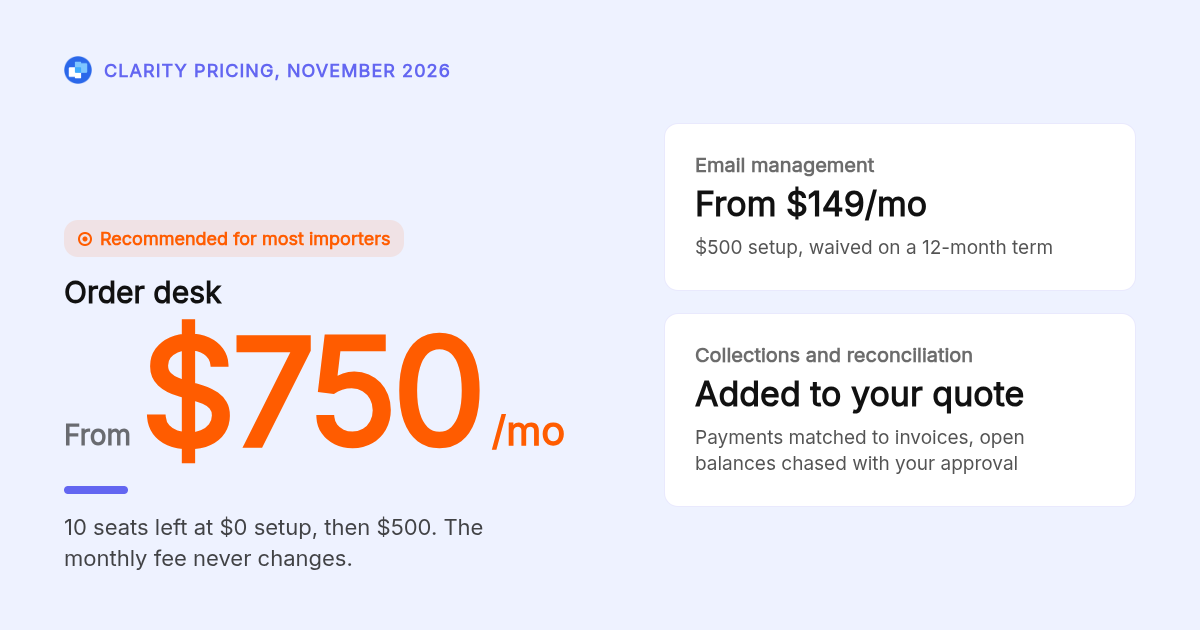
- Clarity's lighter email management plan starts at $149/mo with a $500 setup fee that is waived on a 12-month term.

What does an email management service for importers actually include?
An email management service for importers includes five things: filing each email and attachment on the right purchase order, flagging stalled orders like missed deposits or silent factories, tracking invoices and payments per order, a human review of unclear lines, and quality memory per product and client. Clarity's order desk covers all five and works with or without an ERP.
The test is simple. If a service only sorts mail by sender or label, you still have to open every thread to learn whether the factory confirmed the ship date.
Filing per order changes that. Each PO becomes one page showing what was said, when, and who owes the next step, with the proforma, packing list and bill of lading attached.
As of November 2026 Clarity has logged 154,636 job updates and tracked 3,878 invoices across its clients. Those numbers come from the order desk doing exactly this filing work every day.
Why do importers confuse inbox services, list sellers and transactional email APIs?
Importers confuse the three because every vendor uses the phrase "email for importers". A list seller such as Bancomail sells contact data. A transactional service such as Twilio SendGrid delivers system notifications at volume. An email management service such as Clarity reads the human threads already in your inbox and keeps each order current. Only the third one tracks replies.
The ranking pages for this search mix all three together, which is why so many importers buy the wrong thing first. The table below separates them by the job each one does.
| Option | Best for | Pricing or format | Standout limit |
|---|---|---|---|
| Clarity order desk | Knowing where every live order stands | From $750/mo as of November 2026 | Does not sell contacts or send bulk campaigns |
| Shared inbox or CRM (Front, SalesDrip) | Team visibility on shared addresses | Per-seat subscription; confirm current pricing on each vendor's site | Threads are organised by contact, not by purchase order, unless you tag manually |
| Importer email lists (Bancomail) | Finding new prospects fast | Priced per pack by country and segment; confirm on the vendor's site | Unknown consent and bounce rates, legal exposure |
| Transactional email (Twilio SendGrid) | Automated notifications from software | Tiered by monthly sending volume; confirm on the vendor's pricing page | Does not read or file the replies that come back |
Picking Front or SalesDrip is reasonable if your main problem is a crowded info@ address. Picking a list is reasonable only if you have a separate sending domain, which we cover below.
How much does an email management service for importers cost?
Clarity's order desk costs from $750/mo as of November 2026, and that monthly fee never changes. Ten seats remain at a $0 setup fee; after those are gone setup is $500, rising $250 every 10 seats. Clarity's lighter email management plan starts at $149/mo with a $500 setup fee, waived on a 12-month term.
The pricing model matters more than the headline number. Per-seat shared inboxes grow every time you add a buyer or an assistant, while Clarity's order desk starts from $750/mo and your $750/mo never changes once you are on it.
Mainbridge Import runs 261 live orders on Clarity, so the order desk is already proven at that volume.
Collections and reconciliation are added to your quote rather than priced on a public tier. That service reads remittances, e-transfer notices and bank statements as they land, matches each payment to the invoice it settles, and chases open invoices on the same follow-up ladder. Chasing money never sends without you.
How does Clarity file supplier, forwarder and broker emails onto the right order?
Clarity connects the inboxes an importer already uses, reads each incoming email and attachment, and files it on the matching purchase order. Stalled orders get flagged: missed deposits, silent factories, unpaid invoices. A person on the Clarity team checks every unclear line, and quality notes accumulate per product and per client so repeat problems are visible on the next order.
This is the part we have actually run, not a feature list. Across 100+ businesses Clarity has opened 3,601 jobs, written 58,076 replies and sent 20,932 of them as of November 2026.
The gap between replies written and replies sent is deliberate. Drafts wait for review, and anything that touches money or a factory commitment goes out only after the client approves it.
On the order desk, stalled orders surface as flags rather than in a monthly report: deposits overdue, factories that have not answered and invoices unpaid. The monthly report is a feature of Clarity's email management plan, from $149/mo, rather than the order desk.
Should an importer buy a verified importer or exporter email list?
Buying an importer or exporter email list is rarely worth it. Purchased lists carry unknown consent, stale addresses and spam traps, and Google's bulk sender guidelines require senders to keep reported spam rates under 0.3%. A list that bounces or gets flagged can damage the same domain your supplier and broker threads depend on.
The legal picture differs by region. In the United States the FTC's CAN-SPAM compliance guide allows unsolicited B2B email but requires accurate headers, a physical postal address and opt-outs honoured within 10 business days.
In the EU the General Data Protection Regulation requires a lawful basis under Article 6 for processing a named person's business email, and the right to object under Article 21. Australia's Spam Act 2003, enforced by the ACMA, requires consent, sender identification and a working unsubscribe.
Deliverability is the quieter risk. Google's email sender guidelines require SPF, DKIM and DMARC plus one-click unsubscribe for anyone sending 5,000 or more messages a day to Gmail, and a spam rate under 0.3% in Postmaster Tools.
Our decision rule: never send cold volume from the domain that carries your order threads. If a list campaign gets that domain flagged, your factory's next ship-date confirmation can land in spam.
How can trade data find qualified contacts instead of generic lists?
US vessel manifest data is public under 19 CFR 103.31, so services such as ImportGenius and Panjiva compile bill of lading records into searchable databases. Trade data shows who actually ships what, from which supplier and how often, which qualifies a contact far better than a scraped email list. Expect subscription pricing and manual, one-to-one outreach.
The regulation itself is on the eCFR at 19 CFR 103.31. Shippers can request confidentiality for names, so coverage has gaps, but volume, product descriptions and ports are usually present.
ImportGenius and Panjiva both sell access on subscription; confirm current plans on their sites. Neither gives you an email address, so the workflow is: find the company, find the buyer, write one personal email.
That workflow fits an email management service well, because each prospect thread becomes a workstream with a next step and a follow-up date rather than a row in a spreadsheet.
How should an importer structure inbox management per shipment, regardless of vendor?
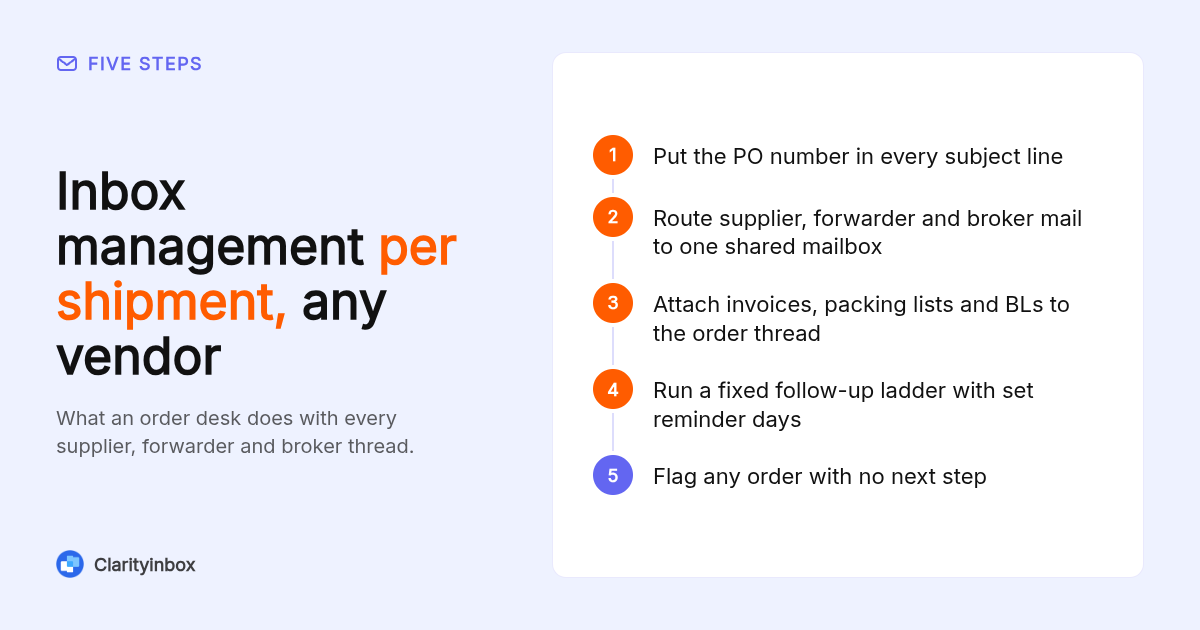
Structure importer inbox management around the purchase order number, not the sender. Put the PO number in every subject line, route supplier, forwarder and broker mail into one shared mailbox, keep invoices, packing lists and bills of lading attached to the order thread, and run a fixed follow-up ladder with set reminder days for each stage.
Start with the address. A shared mailbox in Outlook is free under 50 GB and takes about two minutes to set up, which is the right home for orders@ or imports@.
Then label by order. Clarity can automatically label emails in Gmail or categorize emails in Outlook by reading the content, so a factory reply with no PO in the subject still lands on the right order.
Then set the ladder. Follow-up reminders fire when a forwarder has not answered, and the invoice email subject lines we publish work for deposit and balance requests.
A worked example: PO 2211 ships in six weeks. Day 0 deposit request, day 3 reminder if unpaid, day 14 production check-in, day 28 pre-shipment inspection request, day 35 booking confirmation from the forwarder. Any missed rung is a flag, not a surprise.
When does an importer need a transactional email service alongside an inbox service?
An importer needs a transactional email service only when software, not a person, sends the message. Order confirmations from a webshop, automated tracking updates and warehouse receipts belong on Twilio SendGrid or a similar API. Human threads with factories, forwarders and brokers belong in an email management service, because those replies need reading and filing.
Twilio SendGrid prices by monthly sending volume; confirm current tiers on its pricing page. The service is excellent at delivery and useless at reading what comes back.
The practical split: if your customers receive more than a handful of identical status emails per shipment, generate those from your ERP or webshop through an API. Keep the negotiation, the claims and the exceptions in the inbox, where Clarity files them.
How did we compare these options?
We compared published pricing pages and plan descriptions for Clarity, Front, Twilio SendGrid, Bancomail, ImportGenius and Panjiva as of November 2026, and the scope each one states on its own site. Legal and deliverability points come from the FTC, EUR-Lex, the ACMA and Google's sender documentation. Clarity figures come from our own usage data and price list.
How do you get started with Clarity's order desk?
Connect the inboxes you already use, show us how an order moves from PO to delivery, and the Clarity team files your live orders and starts flagging what has stalled. Ten seats remain at a $0 setup fee as of November 2026, and the $750/mo never changes. See how the order desk works and book a walkthrough.
What do people also ask?
What is the best email management tool for an import company juggling suppliers, forwarders and customs brokers in one inbox?
Clarity's order desk, from $750/mo as of November 2026, files every supplier, forwarder and broker email on the matching purchase order, flags stalled orders and has a person check unclear lines. Shared inboxes like Front organise by contact instead of by order, so they need manual tagging to do the same job.
Should an importer buy a verified importer or exporter email list, and how accurate are they?
Usually not. Purchased lists have unknown consent and freshness, bounce rates that can push a domain over Google's 0.3% spam rate threshold, and legal exposure under GDPR and Australia's Spam Act. If you must test one, send from a separate domain and confirm the vendor's pricing and refresh policy before paying.
How do I connect multiple email accounts and track all communication tied to a specific shipment?
Route every account into one shared mailbox, put the PO number in each subject line, and use a service that files by order rather than by sender. Clarity connects the inboxes you already use and files each email and attachment on the right order, with or without an ERP.
What is the difference between a freight CRM, a transactional email service and an email list provider?
A freight CRM or email management service tracks human threads and replies per shipment. A transactional email service such as Twilio SendGrid sends automated notifications from software. An email list provider sells contact data. Most importers need the first, some need the second, and few benefit from the third.
How do I automate follow-ups and shipment-status emails without losing track of replies?
Split them. Let your ERP or webshop send status notifications through a transactional API, and keep follow-ups to factories and forwarders in an email management service that reads the replies. Clarity drafts follow-ups on a fixed ladder, files the answers on the order, and never sends a money-related chase without your approval.