

How to Chase a Supplier for a Late Order Without Burning Bridges
Knowing how to chase a supplier for a late order comes down to three moves: check the agreed terms first, ask one specific question with a reply deadline, then escalate on a fixed day-by-day ladder. For importers and trading companies juggling dozens of purchase orders, we recommend Clarity's order desk (from $750/mo as of November 2026), which files every PO and supplier email on the right order and flags silent factories before you notice. Clarity is not a freight forwarder or a sourcing agent: it does not ship goods or negotiate for you. It keeps the chase organised and drafts the emails for your review.

Key takeaways:
- Check first: A credible chaser cites the PO number, the agreed ship date and the Incoterms rule, because FOB and EXW put 'late' at different physical points.
- Escalation ladder: Day 1 friendly reminder, day 3 firm chaser, day 5 phone call, day 7 escalation to a senior contact, day 10 formal written notice with a cure deadline.
- Expedite rule: Pay for expedited freight yourself only when the upcharge is smaller than the margin and customer penalties at risk; ask the supplier to pay when the delay is their fault.
- Legal position: UCC section 2-711 lets a buyer cancel and buy replacement goods after a seller fails to deliver, and CISG Article 47 lets a buyer set an additional deadline in writing.
- Clarity's order desk: Clarity's order desk starts at $750/mo, flags missed deposits, silent factories and unpaid invoices, and runs 261 live orders for Mainbridge Import as of November 2026.
What does chasing a supplier for a late order actually involve?
Chasing a supplier for a late order is the structured process of confirming the agreed delivery date, asking the supplier for a revised ETA and reason, then escalating in fixed steps until goods ship or you exercise your contract rights. The fastest fix is a tracked workstream per order, which is what Clarity's order desk provides from $750/mo.
The supplier you chase this week is usually the supplier you reorder from next quarter. That is why tone and sequence matter as much as the ask itself.
Most guides on this topic point the other way, at chasing late invoices or apologising to customers. A buyer chasing a factory needs a different script, and that is what follows.
What should you check before you send the first chaser?
Before chasing, confirm four things: the PO number and quantities, the agreed ship or delivery date, the Incoterms rule that says who arranges carriage, and any late-delivery clause in your purchase terms. A supplier who is late against the wrong date, or against a date you never confirmed in writing, cannot be chased credibly.
Start with the Incoterms rule on the PO. Under the ICC's Incoterms 2020 rules, FOB means the supplier's job ends when goods are loaded at the named port, while EXW means goods only need to be ready at their door. A supplier can be on time under EXW while your container is nowhere near a ship.
Then assess impact. Decision rule: if the order feeds a dated customer commitment inside 14 days, or stops a production line, skip the friendly reminder and open with the day 3 firm chaser. With four weeks of stock cover, the full ladder applies.
How do you politely ask a supplier where your late order is?
A polite chaser names the PO number, states the original due date, asks for one thing (a confirmed revised ship date plus the reason), and gives a reply deadline. Keep the subject line specific, avoid blame words like 'unacceptable' in the first message, and offer a split shipment so the supplier has an easy yes.
Here is a first chaser you can copy. Swap in your own PO, dates and names.
Subject: PO 4471: revised ship date needed (was due 12 Nov)
Hi Mei, PO 4471 was due to ship on 12 November under FOB Shenzhen terms and we have not received shipping documents. Could you confirm the revised ship date and the reason for the delay by end of day Thursday? If part of the order is finished, let us know and we can discuss a split shipment. Thanks, Dan
The subject line does the heavy lifting. Our library of follow-up email subject lines for when nobody replied includes more variants plus a free tester to score your own.
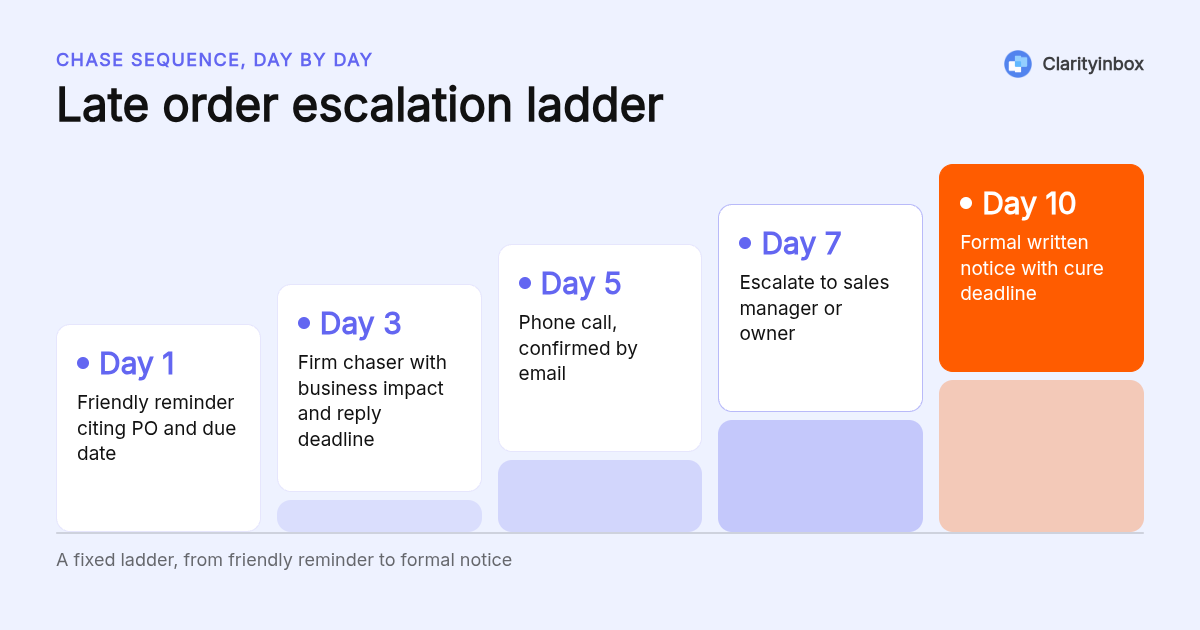
What does a timed escalation ladder for a late order look like?
A timed escalation ladder for a late order runs: day 1 friendly reminder by email, day 3 firm chaser with a stated business impact, day 5 phone call to your contact, day 7 escalation to the account manager or owner, day 10 formal written notice with a cure deadline. Each step references the previous one so the trail is unbroken.
Day 3 firm chaser:
Subject: PO 4471: second request, confirmed date needed by Friday
Hi Mei, following my note on Monday, PO 4471 is now three days past the agreed ship date and we still have no revised ETA. This order feeds a customer delivery on 28 November. Please send a confirmed ship date by Friday 12:00 your time. If I do not hear back, I will call and copy Mr Chen.
Day 5 phone call, 90 seconds: state the PO, ask what is physically blocking shipment (materials, QC, capacity, your own deposit), ask for a date you can repeat to your customer, and say you will confirm the call by email. Then send that email.
Day 7 escalation: forward the thread to the sales manager or owner with one line asking them to own PO 4471 since no confirmed date has arrived since 12 November. Day 10 is formal notice, covered below.
Set the next reminder the moment you send each message. Follow-up reminders that watch your sent mail remove the risk of forgetting day 3 because day 2 was busy, and scheduling the send lands your chaser at 9:00 in the factory's time zone.
Which levers speed up a late order, and who pays for them?
Four levers speed up a late order: a partial or split shipment of finished units, expedited freight such as air instead of sea, priority on the supplier's production line, and flexibility on packaging or quantity. The supplier should pay the freight upcharge when the delay is their fault; you pay when the delay is yours or a shared forecast miss.
Worked example. An order of 2,000 units carries $9,000 of margin and your customer contract charges $2,500 per week late. Air freight for the first 600 units costs $1,800 more than sea. Paying the upcharge, even in full, protects $9,000 plus the penalty, so the decision is easy.
Ask for the supplier's share in the same email where you accept the revised date: you will take 600 units by air on 20 November, and you ask them to confirm they will cover the air freight difference since the delay was production-side. Written, specific, no argument.
Flexibility on your side is a lever too. Accepting 1,800 units now and 200 later often unblocks a factory faster than any threat.
What do you do when the supplier stops replying?
When a supplier goes silent, change channel before changing tone: call the factory line, message your contact on WeChat or LinkedIn, and email a second named person such as the sales manager or owner. If 48 hours pass with no response after a call, send formal notice and start pricing a backup supplier in parallel.
Silence is one of the three stall patterns Clarity's order desk flags as its own alert, alongside missed deposits and unpaid invoices, rather than waiting for you to notice a gap in the thread.
Backup sourcing is not an overreaction. McKinsey's research on global value chains found companies experience a supply disruption of a month or longer every 3.7 years on average. A second qualified supplier for your top products is insurance you will use.
Keep chasing the original supplier while you price the alternative. If they ship, cancel the backup quote with thanks and keep that contact warm.
When can you cancel a late order or claim compensation?
You can cancel a late order when the contract makes time of the essence, when a late-delivery clause gives a cancellation right, or when the supplier misses a reasonable additional deadline you set in writing. Compensation depends on your agreed penalty clause; without one, you are limited to provable losses such as cover costs or customer penalties.
In the United States, UCC section 2-711 gives a buyer whose seller fails to deliver the right to cancel and to cover by buying substitute goods. In the UK, section 10 of the Sale of Goods Act 1979 says whether a delivery time is of the essence depends on the contract terms, so write it in.
For cross-border contracts, CISG Article 47 lets the buyer fix an additional period of reasonable length for performance, and Article 49 allows avoiding the contract if the seller does not deliver within it. That is the legal backbone of the day 10 notice:
Subject: PO 4471: formal notice of late delivery
Dear Mr Chen, PO 4471 was due to ship on 12 November and remains unshipped as of 22 November. We require shipment by 29 November. If goods do not ship by that date, we reserve the right to cancel the order, recover the deposit paid, and source replacement goods at your cost under our purchase terms. Please confirm receipt.
None of this is legal advice; check your own contract and jurisdiction before relying on it.
How do you tell your own customers about a supplier-caused delay?
Tell customers about a supplier-caused delay as soon as you have a revised date, not before, and never blame the supplier by name. State the new date, what you are doing to protect it (split shipment, air freight), and one option they can take now, such as a partial delivery or a substitute. Confirm it in writing the same day.
A short, honest note protects the account better than silence: the order is now scheduled for 3 December instead of 26 November, the first 600 units are coming by air for 20 November, and a refund on the balance is available on reply.
If you handle dozens of these, auto-drafted replies that learn from your sent mail keep the tone consistent while you review each one before it goes.
How do you stop the same supplier being late again?
Prevent repeat delays by logging every promised date and every missed date per supplier, agreeing an on-time threshold (for example 90 percent within 5 days of the agreed date), adding a late-delivery clause to the next PO, and qualifying one backup supplier for your top three products. Review the record at every reorder.
A scorecard needs three columns per order: promised date, actual date, days late. After five orders you have a pattern no sales pitch can argue with, and a number to put beside the next price negotiation.
Add a penalty clause to the next PO, for example a 1 percent price reduction per week late capped at 10 percent. Suppliers who resist a mild clause are telling you something.
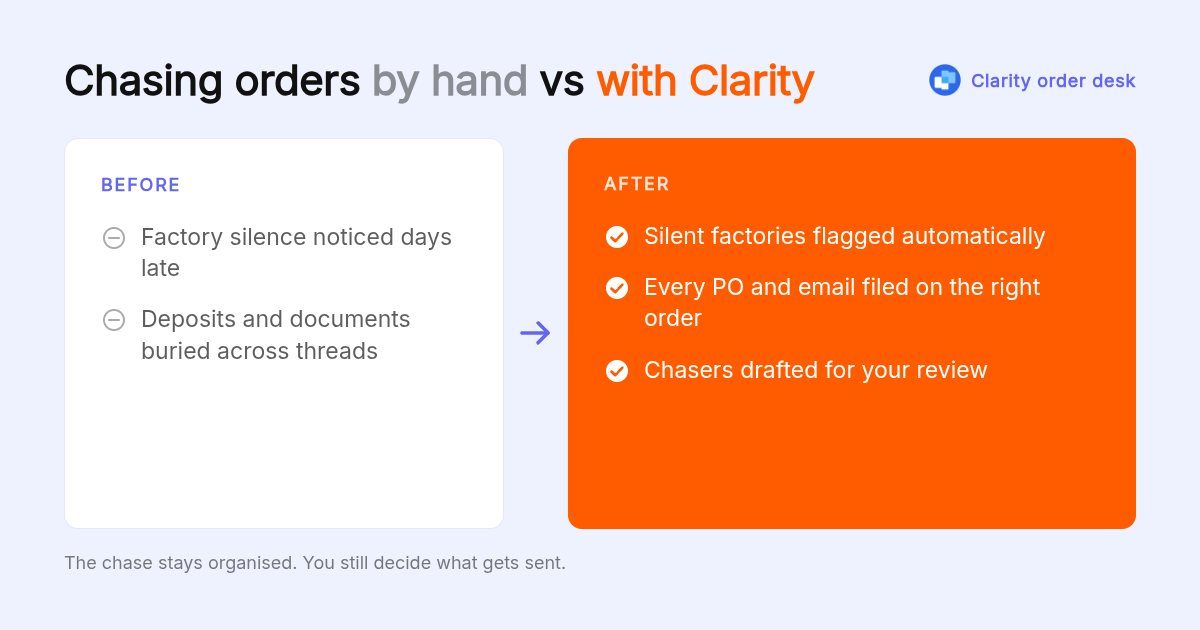
How does Clarity's order desk catch a late order before you have to chase?
Clarity's order desk files every purchase order and supplier email on the right order, then flags stalled orders: missed deposits, silent factories and unpaid invoices. A person on the Clarity team checks every unclear line, and chaser emails are drafted for you to review. Mainbridge Import runs 261 live orders this way, as of November 2026.
Across the 100+ service businesses we serve, Clarity has logged 154,636 job updates and written 58,076 replies, of which 20,932 were sent after review, as of November 2026. On an order desk, those updates are deposit confirmations, factory replies, document arrivals and the gaps between them.
Pricing as of November 2026: $750/mo, with 10 seats left at a $0 setup fee, then $500, rising $250 every 10 seats. The $750/mo never changes. It works with or without an ERP, and quality memory per product and client means last year's defect is in front of you before you approve the reorder.
What Clarity does not do: it does not ship goods, inspect factories or negotiate for you. For a smaller service business that just needs overdue follow-ups caught, our email management service from $149/mo flags people gone quiet and sends a morning brief of what needs attention.
How did we build this escalation ladder?
We compared delivery obligations under Incoterms 2020, buyer remedies in UCC Article 2, the UK Sale of Goods Act and the CISG, and the stall patterns Clarity's order desk flags on live importer orders: missed deposits, silent factories, unpaid invoices. The day counts are a working default, not survey data; shorten them when your contract demands it.
How do you get started with Clarity?
Getting started with Clarity means connecting the inbox you already use, after which the Clarity team maps how your orders flow from PO to shipment and begins filing every email on the right order. Order desk pricing is $750/mo as of November 2026, and 10 seats remain at a $0 setup fee.
From there, stalled orders are flagged before they cost you a customer, and every chaser is drafted in your voice for a one-click review. See how Clarity runs an order from PO to payment and ask about the remaining $0 setup seats.
What do people also ask?
How do I professionally ask a supplier or customer for an overdue payment?
Use the same ladder as a late order: a friendly reminder on day 1 citing the invoice number and due date, a firm chaser on day 3 with a reply deadline, a call on day 5, then a formal notice. Clarity's collections service chases open invoices on that follow-up ladder, and chasing money never sends without you.
How can I ensure timely delivery of orders from a supplier?
Confirm the ship date and Incoterms rule in writing on the PO, pay deposits on time, ask for a production update two weeks before the ship date, log promised versus actual dates per supplier, and add a late-delivery clause to repeat orders. Clarity's order desk flags missed deposits and silent factories before the date slips.
How do I tell a customer about a delay caused by my supplier?
Wait until you have a confirmed revised date, then send one short note with the new date, what you are doing to protect it (split shipment or air freight), and one option the customer can choose now, such as a partial delivery or a refund on the balance. Do not name or blame the supplier.
How do I request urgent or expedited delivery from a supplier?
Ask for a split shipment of finished units by air, name the quantity and the date you need it, and state who pays: the supplier covers the upcharge if the delay was production-side, you cover it if the rush is your own. Expedite when the upcharge is smaller than the margin and penalties at risk.
How long should I wait before chasing a late delivery, and how often should I follow up?
Send the first chaser the day after the agreed ship date passes, a firm chaser on day 3, a phone call on day 5, an escalation to the sales manager on day 7, and formal written notice on day 10. If the order feeds a customer commitment inside 14 days, start at the day 3 step.